Chapter Roadmap
🧭BARTER SYSTEM & ITS PROBLEMS
MONEY: FUNCTIONS & EVOLUTION
DEMAND FOR MONEY (MD) & Liquidity Preference
SUPPLY OF MONEY (MS) & Interest Rate
Theme: money evolved to solve barter's problems and now serves four core functions. Households, businesses and government all demand money for different motives (Keynes' liquidity preference); this demand, interacting with a centrally-controlled money supply, determines the market rate of interest.
Key Definitions
📘Barter
The exchange of one economic good or service directly for another, without money.
Money (Prof. Crowther)
Anything generally acceptable as a means of exchange, which also acts as a measure and store of value.
Fiat Money
Has NO intrinsic value; government-issued currency not backed by a commodity, accepted only due to government order.
Credit Money
Any monetary claim against a physical/legal person that can be used to purchase goods/services (verbal, written agreement, or financial instrument like a bond).
Demand for Money (MD)
All else equal, the amount of money people wish to hold at a given time, at different interest rates – the desire to hold cash or liquid assets.
Liquidity Trap
A situation where interest rates are already very low and liquidity preference is high, making monetary policy ineffective.
Bond
An investment bought upfront by an investor, which pays a fixed amount in return at regular intervals (usually annually).
Supply of Money (MS)
Total stock of money in circulation in a country at a given time – includes currency notes, coins, and bank demand deposits.
Disadvantages of the Barter System
📌- Coincidence of wants: both parties must simultaneously want what the other offers (rice-for-cotton example)
- Rate of exchange: no easy way to agree a fair exchange rate between very different goods
- Indivisibility of goods: many goods (chair, table) can't be split for smaller trades
- Store of value: perishable goods (sugarcane) can't be stored for future wealth
- Transfer of wealth: immovable goods (land, house) are hard to transfer/relocate
- Difficulties in tax collection: taxes collected in goods (e.g. wheat) can't fund infrastructure (roads, hospitals)
Four Functions of Money
⚙️MEDIUM OF EXCHANGE
- Lets agents trade goods without needing to barter
UNIT OF ACCOUNT
- Allows comparing relative prices via a common denomination
STORE OF VALUE
- Lets people forgo consumption now and retrieve resources later
STANDARD OF DEFERRED PAYMENTS
- Allows consuming now while paying in future periods
Three Views on the Role of Money
💵| School | View |
|---|---|
| Classical economists | Money is a passive "lubricant" – markets balance supply & demand on their own; money is neutral |
| Keynesian economists | Money also acts as a STORE OF VALUE, not just a trade facilitator – this contradicts the classical "neutral money" view |
| Monetarists | Money affects AGGREGATE EXPENDITURE via the interest rate – can boost SHORT-RUN output, but expanding money supply ultimately causes inflation and affects LONG-RUN unemployment |
Evolutionary Stages of Money
💵EVOLUTION OF MONEY
Commodity Money
Animals, stones, bones, tobacco, arrows – early standard goods used to solve "coincidence of wants"
Metallic Money
Gold/silver, later minted coins.
Full-bodied: intrinsic value = face value.
Token: intrinsic value < face value.
Paper Money
Began as goldsmith receipts; central banks now issue it.
Convertible: govt. promises gold on demand.
Inconvertible: no such promise.
Fiat Money
No intrinsic value; legal tender by government order only
Credit Money
Monetary claims (verbal/written agreements, bonds) based on trust of future repayment
Electronic/Digital Money
Internet/card-based transactions and fund transfers; fast, cash-free
Characteristics of Good Money
💵GENERAL ACCEPTABILITY
- Must be accepted widely in exchange
STABILITY
- Value must not fluctuate wildly, or deferred payments become unreliable
DURABILITY
- Retains shape/substance over time; issuer (govt.) must also be durable
DIVISIBILITY
- Can be split into small units for varied transactions
TRANSPORTABILITY
- Easy to carry/move between locations
NON-COUNTERFEIT-ABILITY
- Hard to duplicate (e.g. watermarking)
Determinants of Demand for Money
💵Interest rate ↑
Demand for money ↓ (opportunity cost of holding cash rises)
Price level ↑ (inflation)
Demand for money ↑ (need more cash for same purchases)
Real national output (GDP) ↑
Demand for money ↑ (higher income → higher spending)
Financial innovation ↑ (ATMs, cards, online transfer)
Demand for money ↓ (less need to hold physical cash)
Demand for Money: Schedule & Curve
📈| Interest Rate (%) | 10 | 8 | 6 | 4 | 2 |
|---|---|---|---|---|---|
| MD (Rs. billions) | 100 | 200 | 300 | 400 | 500 |
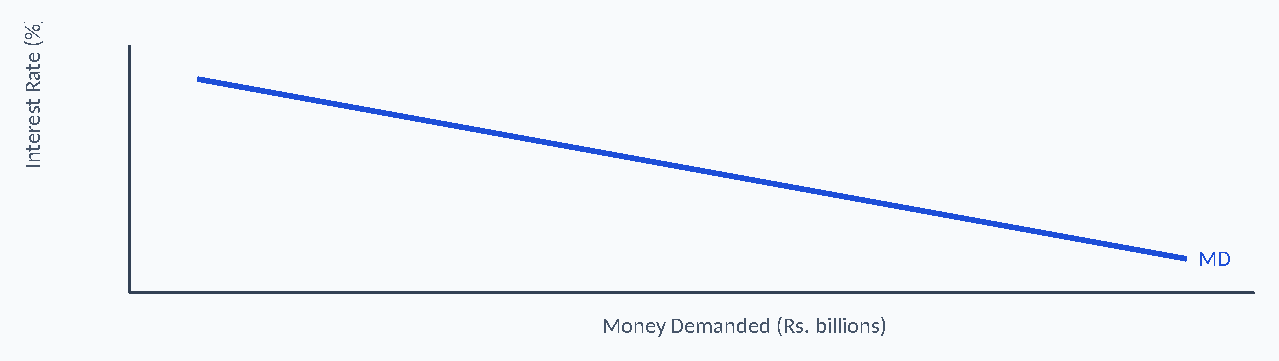
Downward-sloping MD curve: inverse relationship between interest rate and quantity of money demanded – as interest falls, holding cash becomes relatively more attractive.
Shift of the Demand for Money Curve
📈Income ↑ or Price level ↓
MD curve shifts RIGHT (MDo→MD1)
Financial innovation ↑
MD curve shifts LEFT (MDo→MD2)
Any factor OTHER than the interest rate itself causes a SHIFT of the whole MD curve; a change in the interest rate causes only a MOVEMENT along the existing curve.
Keynesian Liquidity Preference – Three Motives
📌TOTAL DEMAND FOR MONEY
MD = Transactional Demand + Precautionary Demand + Speculative Demand
Keynes: people prefer holding liquid cash over illiquid assets, but need a "premium" (interest) to be persuaded to give up liquidity
| Motive | Purpose | Sensitivity to Interest Rate |
|---|---|---|
| Transactional | Day-to-day regular payments; directly proportional to nominal national income | UNAFFECTED by interest rate |
| Precautionary | Held for emergencies (accident, disease) | Inversely related, but relatively INELASTIC |
| Speculative | Held to invest later (e.g. in stocks) when conditions are favourable | Inversely related, and relatively ELASTIC |
Exam clue: Speculative demand is the MOST interest-sensitive of the three; Transactional demand is completely UNaffected by the interest rate.
Liquidity Trap
⚠️At a very low "critical" interest rate (ro), further increases in money supply (MS1→MS2→MS3) fail to lower the interest rate any further – the MD curve turns flat (perfectly elastic) at ro, and people simply absorb the extra money as idle cash, waiting for bond prices to fall.
MEASURES TO OVERCOME THE LIQUIDITY TRAP
- Fiscal policy: e.g. running a larger budget deficit to raise demand directly
- Raise inflation expectations: makes hoarding cash less attractive (its real value falls), boosting consumption
- Raise interest-rate expectations: government borrowing from banks pushes rates up, encouraging bond purchases and pulling the economy out of the trap
Supply of Money – the Liquidity Scale (M0–m3)
💵MONEY SUPPLY CLASSIFICATION
M1 = M0 + Demand Deposits | M2 = M1 + Time Deposits | M3 = M2 + Long-Term Securities
Ordered from MOST liquid (M0) to LEAST liquid (M3)
| Category | Includes | Liquidity |
|---|---|---|
| M0 (Transactional money) | Currency notes & coins | Fully liquid |
| M1 (Checking accounts) | M0 + money in accounts with immediate access | High |
| M2 (Savings deposits) | M1 + time deposits (not immediately accessible) | Medium |
| M3 (Large time assets) | M2 + mutual funds & long-term securities | Most illiquid |
Key rule: for money to hold value, its supply must be FINITE – unlimited production would bid up prices to unsustainable levels. This is why control over money supply is kept with the central bank/government.
Importance of Money Supply
💵An increase in money supply LOWERS the interest rate at which people can borrow – directly affecting the level of both investment and consumption in the economy.
Determination of the Market Interest Rate
📌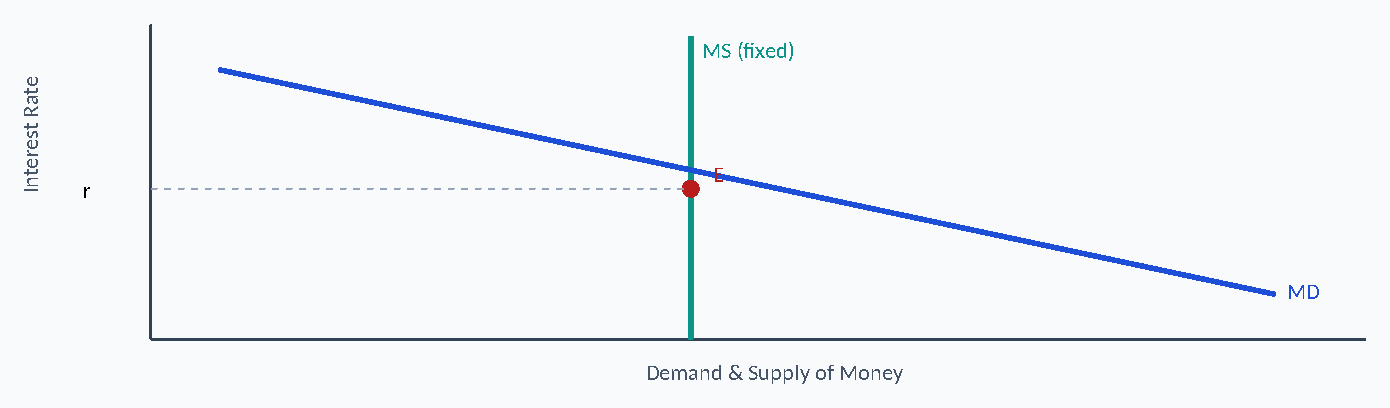
Money supply (MS) is VERTICAL – fixed at a point in time by the central bank, independent of interest rate. It intersects the downward-sloping MD curve at point E, determining the equilibrium market rate of interest, r.
How the Central Bank Shrinks Money Supply (Anti-inflationary)
🏦CENTRAL BANK SELLS SECURITIES
MONEY GOES TO CENTRAL BANK
COMMERCIAL BANK RESERVES ↓
LESS FUNDS AVAILABLE FOR LENDING
MONEY SUPPLY ↓ ⇒
INTEREST RATE ↑
Conversely, in a deflationary situation the central bank BUYS securities from the open market – reserves & lending power rise, money supply expands, and the interest rate FALLS.
Effect of MS Shifts on Interest Rate
🔁| Change | MS Curve Shift | Effect on Interest Rate | Effect on Money Held |
|---|---|---|---|
| Money supply INCREASES | MS → MS1 (right) | Falls (r → r1) | Rises (M → M1) |
| Money supply DECREASES | MS → MS2 (left) | Rises (r → r2) | Falls (M → M2) |
Exam Patterns & MCQ Quick Clues
🎯"Intrinsic value less than face value"
Token money
"No intrinsic value, legal tender only"
Fiat money
"Held for day-to-day payments, unaffected by interest"
Transactional demand for money
"Most sensitive to interest rate changes"
Speculative demand for money
"Mutual funds / long-term securities"
M3
"Interest rate at critical low, MS increase has no effect"
Liquidity trap
"Central bank sells securities"
Money supply shrinks, interest rate rises
⚠ ECONOMICS EXAM TRAPS
Trap: Confusing Full-Bodied Money (intrinsic value = face value) with Token Money (intrinsic value < face value).
Trap: Mixing up Convertible (govt. promises gold) with Inconvertible (no such promise) paper money.
Trap: Treating all three demand-for-money motives as equally interest-sensitive – only precautionary & speculative are interest-related, and only speculative is highly ELASTIC.
Trap: Assuming money supply (MS) responds to interest rate – it is a VERTICAL (fixed) curve set independently by the central bank.
Trap: Reversing the M0-M3 order – M0 is the MOST liquid, M3 is the LEAST liquid (each tier adds a less-liquid asset).
Complete Chapter Decision Tree
📌QUESTION GIVEN → Money form/evolution, demand for money, or supply of money question? → Identify the specific concept (motive, money type, M-category) → Apply relevant definition/rule → For MD/MS: identify whether it's a movement (interest rate change) or shift (other factor) → Interpret & select final answer
PRC-3 ECONOMICS – CHAPTER 9 IN 60 SECONDS
- Money's 4 functions: medium of exchange, unit of account, store of value, standard of deferred payments.
- Evolution: Commodity → Metallic (full-bodied/token) → Paper (convertible/inconvertible) → Fiat → Credit → Electronic.
- MD determinants: interest rate (↓MD), price level (↑MD), real GDP (↑MD), financial innovation (↓MD).
- 3 Keynesian motives: Transactional (income-driven, interest-independent), Precautionary (inelastic), Speculative (elastic).
- Liquidity trap: at critical low interest, MS increases can't lower it further.
- M0<M1<M2<M3 in liquidity terms (M0 most liquid).
- Interest rate determined where MD (downward-sloping) meets MS (vertical, fixed).
- Sell securities → MS↓ → interest rate↑. Buy securities → MS↑ → interest rate↓.
Chapter Memory Map
🧠Preparing for ICAP PRC-3?
Join Learning League for chapter-wise classes, practice MCQs and tests on our student portal. Message us on WhatsApp to enrol.