Chapter Roadmap
🧭PUBLIC FINANCE & ITS SCOPE
FISCAL POLICY
(tools, types, objectives)
TAXATION
(canons & types)
ECONOMIC GROWTH
Theme: public finance is the study of how government raises and spends money to maximize social welfare. This chapter covers its four segments, the fiscal-policy tools built from taxes & spending, the rules (canons) and types of taxation, and finally economic growth – how it is achieved, measured, and its costs & benefits.
Key Definitions
📘Public Finance
Studies the income and expenditure of public authorities and the adjustment between them – how government raises finance for its ever-increasing expenditure.
Fiscal Policy
Government measures to stabilize the economy, especially by manipulating taxes and government expenditure.
Expansionary Fiscal Policy
Increases money supply/spending in the economy (spending ↑ or tax ↓) to fight deflation/recession.
Contractionary Fiscal Policy
Contracts money supply/spending (spending ↓ or tax ↑) to hinder inflationary pressures.
Crowding Out
A policy effect where increased government spending decreases the size of the private sector (e.g. by raising interest rates and discouraging private investment).
Direct Tax
Burden CANNOT be shifted to anyone else – impact and incidence fall on the same person (e.g. Income Tax, Wealth Tax).
Indirect Tax
Burden CAN be shifted to someone else – collected by adding to product prices (e.g. General Sales Tax, Excise Duty).
Progressive / Proportional / Regressive Tax
Progressive: rate ↑ as tax base ↑. Proportional: rate stays FIXED regardless of base. Regressive: poor bear a proportionately GREATER burden than the rich.
Economic Growth
(Friedman) An expansion of the economic system in one or more dimensions without a change in its structure – reflected by an outward shift of the PPF.
Scope of Public Finance – Four Segments
📌PUBLIC FINANCE
Public Expenditure
Objectives & kinds of government spending – helps evaluate overall economic performance
Public Revenue
Tax & non-tax income sources; canons, functions and types of taxation
Public Debt
Arises when expenditure exceeds revenue – needs, sources, impact & management of borrowing
Financial Administration
Economic policy making & implementation to achieve stated objectives
Public Finance vs Private Finance
⚖️| Aspect | Public Finance | Private Finance |
|---|---|---|
| Income & expenditure adjustment | Moves from EXPENDITURE to income (spend first, then raise revenue) | Moves from INCOME to expenditure (spend within means) |
| Budgeting | Annual budgeting is OBLIGATORY | Annual budgeting is OPTIONAL |
| Borrowing | Internal AND external borrowing possible | Only EXTERNAL borrowing available |
| Primary objective | Social welfare | Profit |
| Secrecy | Government is bound to be transparent to the public | Secrecy is a personal choice |
Tools of Fiscal Policy
🏛TOOLS OF FISCAL POLICY
Government Revenue
Tax revenue: income tax, property tax, sales tax, gain tax, wealth tax
Non-tax revenue: fines/penalties, trading profits, rental income, fees, post office income, royalties
Government Expenditure
Development: transport, agricultural development, dams, social services, roads
Non-development: defence, law & order, civil administration, debt servicing
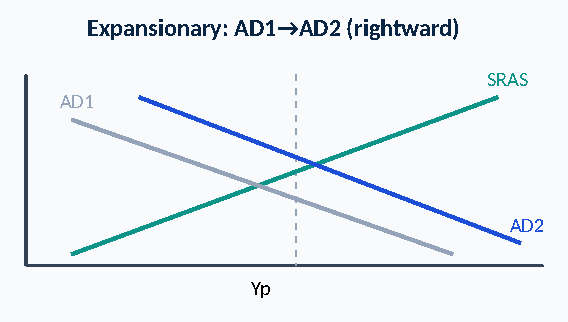
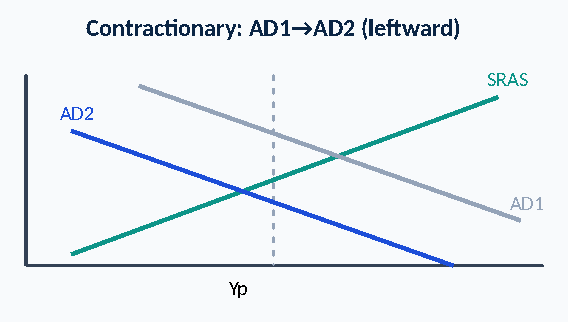
Expansionary vs Contractionary Fiscal Policy
⚖️| Expansionary (Anti-Deflationary) | Contractionary (Anti-Inflationary) | |
|---|---|---|
| Used when | Economy in recession; AD1 intersects SRAS BELOW potential GDP (Yp) | Economy overheating; AD1 intersects SRAS BEYOND potential GDP (Yp), high inflation at P1 |
| Policy actions | Reduce taxes; increase government spending | Increase taxes; reduce government spending |
| Effect on AD | AD shifts RIGHT (AD1→AD2), price rises to P2 at potential GDP Yp | AD shifts LEFT (AD1→AD2), price falls to P2 at potential GDP Yp |
Objectives of Fiscal Policy
🏛KEEP INFLATION LOW
- Stable price level economy-wide
KEEP EMPLOYMENT HIGH
- Social objective of the government
STEADY ECONOMIC GROWTH
- Consistent, gradual growth preferred
BOP EQUILIBRIUM
- Imports & exports value kept equal
BALANCED BUDGET
- Spending matched by what govt. can pay for, no mini-budgets needed
Limitations of Fiscal Policy
🏛- Forecasting: policy is built on economic predictions, which can be inaccurate
- Time lag: delay between when action is needed and when its impact is actually felt
- Crowding out: higher govt. spending funded by borrowing raises interest rates, discouraging private investment – offsetting the original stimulus
- Negative impact of tax: raising taxes to cool AD can demotivate work, reducing productivity/aggregate supply
- Lack of coordination with monetary policy: fiscal policy success depends on alignment with the central bank's actions
Crowding-out example: Govt. plans Rs.100bn spending, financed via heavy borrowing → market interest rate rises → cost of private projects rises → private investors invest less → the fall in private investment OFFSETS the rise in government spending.
Cause & Effect: Fiscal Policy in Action
🔁Recession (AD below Yp)
Govt. cuts tax / raises spending (Expansionary)
AD shifts right, output & price rise toward Yp
Overheating (AD beyond Yp, high inflation)
Govt. raises tax / cuts spending (Contractionary)
AD shifts left, price falls back toward Yp
Functions of Taxation
⚙️FISCAL
- Main source funding development & non-development expenditure
ALLOCATION
- Progressive tax reduces income disparities between groups
REGULATORY
- Manages demand by adjusting tax base/rates
INCENTIVE
- Tax cuts/special arrangements to encourage investment
Canons (Principles) of Taxation – Adam Smith's Core Four
🧾Canon of Equality
Tax should be proportional to each person's ability to pay (their income). Higher income → higher tax rate.
Canon of Certainty
Time, manner, and quantity of tax payment must be CLEAR & not arbitrary – for both the taxpayer and the government.
Canon of Convenience
Tax should be levied at the time/manner most convenient for the taxpayer to pay it (e.g. GST added at time of purchase).
Canon of Economy
Cost of collecting the tax should be small – minimal amount should be lost between the taxpayer's pocket and the treasury.
Other Canons of Taxation
🧾FISCAL ADEQUACY
- Tax should generate enough revenue to meet government expenses; a small tax yielding large revenue beats a heavy tax yielding little
FLEXIBILITY
- Tax system should adjust (not rigid) to changing economic conditions
SIMPLICITY
- Should be simple enough for everyone to understand – complexity invites corruption/oppression
DIVERSITY
- A variety of direct & indirect taxes across sectors (industry, agriculture, services, trade)
Classification of Taxes
🧾TAXATION
By Ability to Shift Burden
Direct Tax: collected directly from who has ability to pay; shifting IMPOSSIBLE
Indirect Tax: collected via product price; shifting POSSIBLE
By Tax Rate
Progressive: rate & base directly proportional
Proportional: rate fixed regardless of base
Regressive: poor bear proportionately more burden
Direct Tax: Advantages vs Disadvantages
🧾| Advantages | Disadvantages |
|---|---|
| Equitable – higher income pays more | Easy to evade (falsify income declared) |
| Economical – low collection cost | Unpopular – people resist visible deductions |
| Relatively certain revenue for planning | Discourages savings/investment if too high |
| Elastic – rises automatically with income/wealth | Less incentive to work harder |
| Anti-inflationary – reduces disposable income, shifts AD left |
Indirect Tax: Advantages vs Disadvantages
🧾| Advantages | Disadvantages |
|---|---|
| Can correct externalities (e.g. tax on cigarettes) | Regressive – poor feel more burden than rich |
| Difficult to evade (built into price) | Causes cost-push inflation |
| Allows consumer choice (pay only when buying) | Can create a black market if prices too high |
| Wide-ranging – reaches those exempt from direct tax | Uncertain revenue (falls in recessions) |
| Helpful in discouraging demerit goods (e.g. alcohol) | Distorts market equilibrium for taxed goods |
Progressive Tax: Advantages vs Disadvantages
🧾| Advantages | Disadvantages |
|---|---|
| Built-in stabilizer (auto-adjusts with income) | Discourages economic activity/saving at high rates |
| Equitable – rich pay more, poor pay less | Encourages tax evasion among high earners |
| Relatively certain (well-defined tax slabs) | Seen as invasion of individual rights by opponents |
| Anti-inflationary – restrains high-income spending | Revenue loss from evasion (usually a direct tax) |
Proportional Tax: Advantages vs Disadvantages
🧾| Advantages | Disadvantages |
|---|---|
| Unambiguous – flat rate, no confusion | Fails canon of equality – poor feel more burden |
| Relatively justified – no discrimination by income group | Relatively inelastic – contributes less total revenue |
| Does not discourage work/saving incentive | Widens income inequality over time |
Regressive tax example: a 17% GST on food means a poor family buying 1 unit and a rich family buying 100 units BOTH pay 17% – but the poor family feels a much heavier relative burden. GST/VAT are classic regressive-tax examples.
Tax Types – Don't Confuse!
🧩| Progressive | Proportional | Regressive | |
|---|---|---|---|
| Rate vs base | Rate ↑ as base ↑ | Rate constant | Burden falls more on the poor |
| Example | Income tax | Zakat / Withholding tax | GST / VAT |
Rostow's Stages of Economic Growth
📌1. Traditional Society — primitive, agriculture-based, no technology/scientific knowledge
2. Pre-Takeoff Stage — shifting from traditional to modern farming, limited mechanization
3. Takeoff Stage — industrial revolution begins; agriculture still dominant but less relatively important
4. Drive to Maturity — technology more relevant; industry diversifies
5. Age of Mass Consumption — leading sectors produce consumer durables; per-capita income & living standards rise
Indicators of Growth & Recession
📌| Indicator | What It Shows | Timing |
|---|---|---|
| Leading | Forecasts an upcoming peak or trough | 3–12 months BEFORE it happens |
| Coincident | Confirms current stage of the economy | AT the same time as the peak/trough |
| Lagging | Confirms past economic trends | 3–12 months AFTER it happened |
Exam clue: "Leading" predicts the future, "Coincident" describes the present, "Lagging" confirms the past – remember by their position relative to the business-cycle turning point.
Costs & Benefits of Economic Growth
💰| Advantages | Disadvantages |
|---|---|
| Higher living standards (more comforts of life) | Environmental concerns (pollution, negative externalities) |
| Increased employment opportunities | Income inequality – gains concentrated among few |
| Fiscal benefits – more tax revenue for government | Inflation risk (demand-pull, as AD rises) |
| Reduction in poverty | Social cost – less leisure/health as people work more |
| Current account deficit (reliance on imported machinery) |
Exam Patterns & MCQ Quick Clues
🎯"Burden cannot be shifted to anyone else"
Direct Tax
"Included in the price of the product"
Indirect Tax
"Poor bear more relative burden than rich"
Regressive Tax (e.g. GST)
"Government cuts tax / raises spending"
Expansionary Fiscal Policy
"Private investment falls due to govt. borrowing"
Crowding out
"Forecasts a peak/trough 3-12 months ahead"
Leading indicator
⚠ ECONOMICS EXAM TRAPS
Trap: Confusing Progressive Tax (rate rises with base) with Proportional Tax (rate fixed) – both are direct-tax-style but behave differently.
Trap: Assuming all indirect taxes are automatically regressive in NAME only – regressive specifically means the poor bear a proportionately larger burden.
Trap: Mixing up expansionary (tax↓/spending↑, fights recession) with contractionary (tax↑/spending↓, fights inflation) fiscal policy.
Trap: Reversing Leading vs Lagging indicators – Leading predicts ahead, Lagging confirms after the fact.
Trap: Forgetting that Public Finance moves from EXPENDITURE to income, the reverse of Private Finance's INCOME to expenditure.
Complete Chapter Decision Tree
📌QUESTION GIVEN → Public finance scope, fiscal policy, taxation, or growth question? → Identify the specific concept (canon, tax type, policy type, indicator) → Match to its defining feature → Apply relevant comparison (Direct/Indirect, Progressive/Proportional/Regressive, Expansionary/Contractionary) → Interpret & select final answer
PRC-3 ECONOMICS – CHAPTER 8 IN 60 SECONDS
- Public finance: 4 segments – expenditure, revenue, debt, financial administration.
- Fiscal policy tools: government revenue (tax/non-tax) & expenditure (development/non-development).
- Expansionary: tax↓/spending↑ (fights recession). Contractionary: tax↑/spending↓ (fights inflation).
- Fiscal policy limits: forecasting, time lag, crowding out, tax disincentive, monetary coordination.
- 4 canons (Smith): Equality, Certainty, Convenience, Economy (+Adequacy, Flexibility, Simplicity, Diversity).
- Direct tax = burden can't shift (income tax); Indirect tax = burden can shift (GST).
- Progressive = rate rises with base; Proportional = flat rate; Regressive = poor bear more.
- Rostow's 5 stages: Traditional → Pre-Takeoff → Takeoff → Drive to Maturity → Mass Consumption.
- Indicators: Leading (before) / Coincident (during) / Lagging (after).
Chapter Memory Map
🧠Preparing for ICAP PRC-3?
Join Learning League for chapter-wise classes, practice MCQs and tests on our student portal. Message us on WhatsApp to enrol.