Chapter Roadmap
🧭BALANCE OF PAYMENTS (BOP) vs Balance of Trade (BOT)
BOP CALCULATIONS
(errors, balancing, terms of trade)
CURRENT ACCOUNT DEFICIT
(causes & corrective measures)
Theme: keeping a systematic record of a country's trade with the rest of the world lets policymakers take corrective action. Balance of Trade covers only visible goods; Balance of Payments is the fuller record covering visible AND invisible items, split across current, capital and financial accounts.
Key Definitions
📘Balance of Payments (BOP)
A comprehensive record of a country's economic transactions with the rest of the world during the course of one year.
Balance of Trade (BOT)
Concerned with the trade of only VISIBLE (tangible) goods – narrower than BOP.
Visible Goods
Tangible items recorded via customs duties, with measurable value (cars, machinery, shoes).
Invisible Goods
Intangible items – financial services, insurance, capital flows.
Net Errors and Omissions
The value needed to ensure the BOP statement's accounts sum to zero – compensates for discrepancies.
Terms of Trade (TOT)
The ratio of export prices to import prices – the amount of import goods an economy can buy per unit of export goods.
Current Account Deficit
A net outflow of demand versus income coming into a country – the country is "not paying its way".
Surplus vs Deficit
⚖️| State | Condition |
|---|---|
| Surplus | Receipts > Payments |
| Deficit | Receipts < Payments |
Balance of Trade vs Balance of Payments
🌍| Balance of Trade (BOT) | Balance of Payments (BOP) | |
|---|---|---|
| Scope | VISIBLE goods only | VISIBLE + INVISIBLE goods (fuller/wider record) |
| Examples included | Cars, machinery, shoes | All of BOT + financial services, insurance, capital flows |
Components of Balance of Payments
📌BALANCE OF PAYMENTS (BOP)
Current Account
Trade in goods; Trade in services; Investment income; Transfers (e.g. overseas aid)
Capital Account
Records capital flows such as transfers between countries
Financial Account
Real FDI; Portfolio investment; Financial derivatives; Reserve assets
Financial Account – Key Terms
📌REAL FOREIGN DIRECT INVESTMENT (FDI)
- Domestic firm sets up a factory abroad and earns money from it
PORTFOLIO INVESTMENT
- Domestic investor buys shares in an already-established foreign business (no control over the company)
FINANCIAL DERIVATIVES
- Instruments whose value is based on an underlying asset
RESERVE ASSETS
- Foreign financial assets a central bank uses to cover deficits/imbalances
Worked Example: Building a BOP Statement
🧪| BOP Item | Rs. bn | Net Balance |
|---|---|---|
| Exports (visible) | 10 | – |
| Imports (visible) | 22 | – |
| Trade Balance (visible) | −12 | |
| Export (services) | 11 | – |
| Import (services) | 29 | – |
| Trade Balance (invisible) | −18 | |
| Investment Income (net) | +4 | |
| Net Transfers | −24 | |
| CURRENT ACCOUNT BALANCE | −50 | |
| Capital Account (net transfers) | +15 | |
| Financial Account (FDI, portfolio, reserves, errors) | +35 | |
| CAPITAL + FINANCIAL ACCOUNT BALANCE | +50 | |
| Overall Balance of Payments | 0 |
The current account deficit (−50) is exactly offset by the capital + financial account surplus (+50) – illustrating how a current account deficit is financed elsewhere in the BOP so the OVERALL balance nets to zero.
Real-world context: Pakistan's current account has run persistent deficits in most years on record (e.g. State Bank of Pakistan data shows deficits across 2017-18 through most recent years), financed mainly through the financial account and capital inflows.
Net Errors and Omissions
📌In theory, BOP accounts should balance exactly; in practice they rarely do. "Net Errors and Omissions" is the plug figure that compensates for this discrepancy, ensuring the statement sums to zero.
Balancing a BOP Deficit or Surplus
📌| Situation | Balanced By |
|---|---|
| Deficit | Selling gold/financial reserves; Borrowing from other central banks |
| Surplus | Buying gold/financial reserves; Paying off debts |
Importance of BOP Calculation
⭐BOP shows a deficit (imports > exports)
Government works to improve export quantity/quality
BOP deficit
Guides PROTECTION policy – restrict imports or subsidise domestic producers
BOP deficit in specific sectors
Guides BUDGET ALLOCATION toward weak-performing sectors
BOP deficit
Guides FISCAL & MONETARY policy – e.g. lower interest rate to boost investment
BOP deficit (imports > exports)
Guides DEVALUATION policy to encourage exports/discourage imports
Terms of Trade (TOT)
🌍TERMS OF TRADE
TOT = (Export Price Index of Current Year ÷ Import Price Index of Current Year) × 100
TOT > 100 = improvement; TOT < 100 = deterioration
Worked example: Export price index rises 20% (→120); import price index rises 10% (→110) ⇒ TOT = (120÷110)×100 = 109.09 (≈109) ⇒ TOT improved by 9%.
Improvement vs Deterioration in Terms of Trade
🌍| Situation | TOT Effect |
|---|---|
| Export prices rise FASTER than import prices | TOT IMPROVES |
| Import prices rise FASTER than export prices | TOT WORSENS |
Important exam nuance: an improving TOT does NOT automatically improve the BOP. TOT looks only at PRICES; BOP depends on both price AND quantity. A rise in export prices (improving TOT) could cause a proportionately BIGGER fall in export demand – actually WORSENING the balance of payments. The reverse logic applies to a worsening TOT.
Causes of a Current Account Deficit
🔁- High income elasticity of demand for imports: strong consumer spending → imports rise fast
- Long-term decline in manufacturing potential: less capacity to produce/export goods
- Changes in commodity prices: swings in imported raw-material prices worsen the deficit
- Inelastic imports: a major cause – import volume doesn't fall much even as price rises
- Domestic inflation: makes cheaper imports more attractive, worsening the deficit
Non-monetary Corrective Measures
📏TARIFFS
- Duty on imports raises their price, making them less attractive; protects domestic suppliers
QUOTAS
- Government fixes a maximum quantity of a good that can be imported, directly cutting import volume
EXPORT PROMOTION
- Exhibitions, trade fairs, diplomatic deals to help exporters sell abroad
IMPORT SUBSTITUTION
- Becoming self-reliant via domestic training, subsidies, tax assistance instead of importing
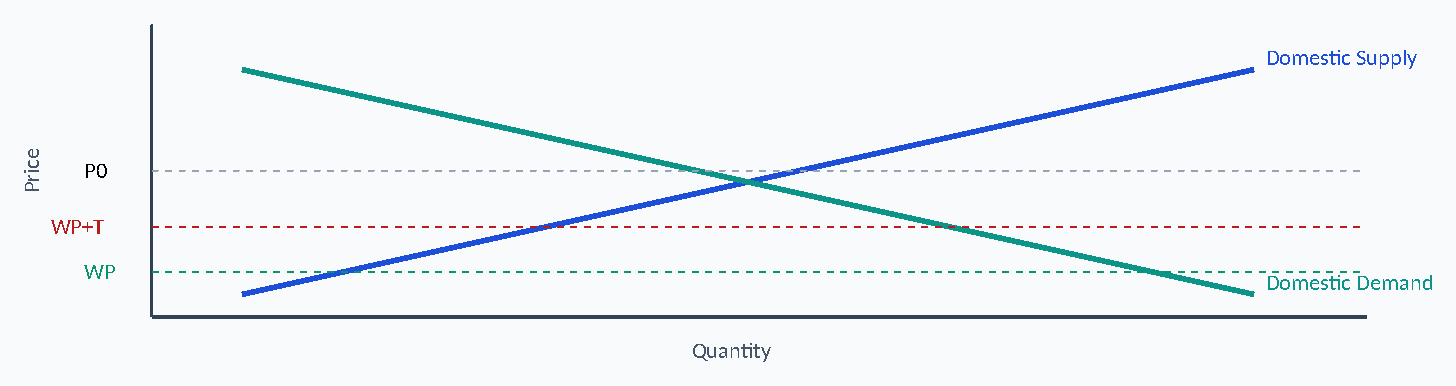
At world price WP, imports = Qs1 to Qd1 (a large gap). Adding a tariff raises the effective import price to WP+T, narrowing the import gap to Qs2–Qd2 – a SMALLER volume needs to be imported, improving the current account deficit.
Monetary Corrective Measures
📏DEFLATION
- Lower domestic price level → goods more attractive abroad → exports ↑
EXCHANGE CONTROL
- Authority commands exporters to surrender forex reserves to the central bank, restricting import levels
EXCHANGE RATE DEPRECIATION
- Domestic currency made cheaper relative to foreign currency, boosting exports & discouraging imports
Worked example: Car priced Rs.40,000; exchange rate Rs.4=$1 ⇒ costs US buyer $10,000. Depreciate rate to Rs.5=$1 ⇒ same car now costs only $8,000 – cheaper for foreign buyers, raising demand for the export and helping correct the current account deficit (while making imports costlier).
Exam Patterns & MCQ Quick Clues
🎯"Export price index ÷ import price index × 100"
Terms of Trade
"Only visible/tangible goods recorded"
Balance of Trade (not BOP)
"FDI, portfolio investment, reserve assets"
Financial Account
"Trade in goods/services, investment income, transfers"
Current Account
"Government fixes maximum import quantity"
Quota
"Currency made cheaper to foreign buyers"
Exchange rate depreciation
⚠ ECONOMICS EXAM TRAPS
Trap: Treating BOT and BOP as synonyms – BOT covers only visible goods; BOP covers visible + invisible.
Trap: Assuming an improving Terms of Trade automatically improves the Balance of Payments – TOT is PRICE-only; BOP depends on price AND quantity together.
Trap: Misclassifying Financial Derivatives or Portfolio Investment as part of the Current Account – they belong to the Financial Account.
Trap: Confusing Tariffs (price-based, raises cost of imports) with Quotas (quantity-based, caps import volume directly).
Trap: Reversing deficit vs surplus balancing methods – deficit is balanced by SELLING reserves/borrowing; surplus by BUYING reserves/paying off debt.
Complete Chapter Decision Tree
📌QUESTION GIVEN → BOP/BOT distinction, BOP component, TOT calculation, or current account deficit question? → Identify the specific account/measure involved → If numerical: apply the Terms of Trade formula → For deficit questions: identify monetary vs non-monetary corrective measure → Interpret & select final answer
PRC-3 ECONOMICS – CHAPTER 12 IN 60 SECONDS
- BOT: visible goods only. BOP: visible + invisible (current + capital + financial accounts).
- Current account: goods, services, investment income, transfers.
- Financial account: FDI, portfolio investment, derivatives, reserve assets.
- Net errors and omissions makes the BOP statement sum to zero.
- Deficit balanced by selling reserves/borrowing; Surplus by buying reserves/paying debt.
- TOT = (Export price index ÷ Import price index) ×100; >100 = improvement.
- Improving TOT does NOT guarantee an improving BOP (quantity effects matter too).
- Current account deficit causes: high import income-elasticity, weak manufacturing, commodity price swings, inelastic imports, domestic inflation.
- Non-monetary fixes: tariffs, quotas, export promotion, import substitution.
- Monetary fixes: deflation, exchange control, exchange rate depreciation.
Chapter Memory Map
🧠Preparing for ICAP PRC-3?
Join Learning League for chapter-wise classes, practice MCQs and tests on our student portal. Message us on WhatsApp to enrol.