Chapter Roadmap
🧭CONSUMPTION & CONSUMPTION FUNCTION
SAVING & SAVING FUNCTION
INVESTMENT & INVESTMENT FUNCTION
NATIONAL INCOME EQUILIBRIUM (C+I = C+S)
Theme: Keynes' theory of income and employment rests on Consumption, Saving and Investment. Households don't consume all their income – the unspent part is saved; firms then convert this pool of saving into investment, and national income equilibrium is reached where C+I = C+S.
Key Definitions
📘Consumption
The fraction of disposable income that households spend on consumer goods.
Autonomous Consumption (Co)
Minimum consumption one must incur regardless of income (basic needs, financed by past savings/borrowing if income is zero).
Induced Consumption (cY)
Portion of consumption that directly depends on one's income level.
Saving
That part of income which is not consumed yet – "postponed consumption" of households or businesses.
Investment
Expenditure by households or firms on CAPITAL GOODS (new buildings, plant, machinery) – must be a quantitative addition to capital stock.
Autonomous Investment
Investment unaffected by changes in national income; often government-led welfare spending (infrastructure, schools, hospitals).
Induced Investment
Investment that varies directly with the level of national income.
Marginal Efficiency of Capital (MEC)
The discount rate that makes the present value of an asset's expected yield equal to its supply price – i.e. the expected rate of return on investment.
Psychological Law of Consumption (Keynes)
📜"People increase their consumption as their income increases, but not by as much as their income increases."
THREE PROPOSITIONS
- Aggregate consumption rises with income, but by LESS than the rise in income
- Whatever is not spent on consumption is SAVED
- Rising income leads to BOTH increased consumption AND increased saving
Consumption Function
⚙️CONSUMPTION FUNCTION
C = f(Y) or C = Co + cY
Co = autonomous consumption (exogenous) | cY = induced consumption (endogenous) | c = MPC = slope of the function
MARGINAL & AVERAGE PROPENSITY TO CONSUME
MPC = ΔC ÷ ΔY | APC = C ÷ Y
By Keynes' law: 0 < MPC < 1 (consumption rises with income, but less than proportionately)
| Income (Y) | Co | C=Co+cY | MPC | APC |
|---|---|---|---|---|
| 0 | 50 | 50 | – | 0 |
| 100 | 50 | 100 | 0.5 | 1 |
| 200 | 50 | 150 | 0.5 | 0.75 |
| 300 | 50 | 200 | 0.5 | 0.67 |
| 500 | 50 | 300 | 0.5 | 0.60 |
Note: APC keeps FALLING as income rises even though MPC stays constant at 0.5 – because autonomous consumption Co is spread over a growing income base.
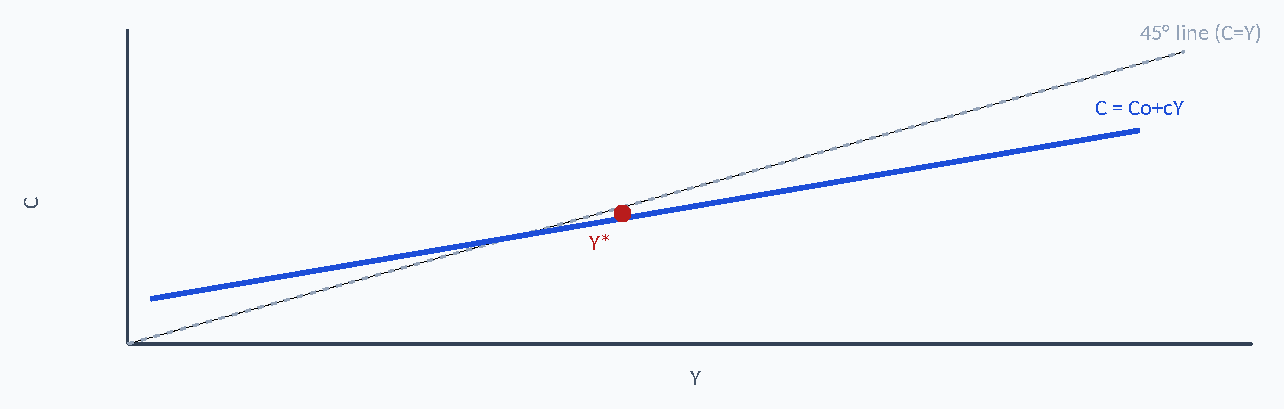
Below Y*, consumption > income (dissaving); beyond Y*, consumption < income (saving begins).
Determinants / Shifts of Consumption Function
⚙️Real income ↑
Consumption ↑
More equal wealth distribution
Consumption ↑ (poor have higher MPC)
Prices expected to rise
Consumption ↑ now (buy before price rise)
Low-income households taxed more
Consumption ↓
Interest rates ↑
Disposable income ↓ (higher repayments) → Consumption ↓
Saving Function
⚙️SAVING FUNCTION
S = f(Y) or S = −So + sY (also: Y = C+S so S = Y−C)
−So = dissaving at zero income (equals autonomous consumption) | s = MPS = slope of the saving function
MARGINAL & AVERAGE PROPENSITY TO SAVE
MPS = ΔS ÷ ΔY | APS = S ÷ Y
Saving is DIRECTLY proportional to income
MPC + MPS = 1 – Derivation
📌Y = C + S → ΔY = ΔC + ΔS → Divide both sides by ΔY: ΔY/ΔY = ΔC/ΔY + ΔS/ΔY → 1 = MPC + MPS
Since 0<MPC<1, it follows that 0<MPS<1. Worked example: Income rises Rs.10,000; Rs.7,000 consumed, Rs.3,000 saved ⇒ MPC=0.7, MPS=0.3, and 0.7+0.3=1.
| Income (Y) | Consumption | Saving | MPS | APS |
|---|---|---|---|---|
| 0 | 50 | −50 | – | – |
| 100 | 100 | 0 | 0.5 | 0 |
| 200 | 150 | 50 | 0.5 | 0.25 |
| 300 | 200 | 100 | 0.5 | 0.33 |
| 500 | 300 | 200 | 0.5 | 0.4 |
At zero income, saving is negative (−50) – this dissaving exactly equals autonomous consumption, financed from past savings or borrowing. Saving turns positive once income passes Y* (the break-even point on the consumption graph).
Determinants of Saving
📌OBJECTIVE FACTORS
- Level of income (direct relation)
- Net wealth ↓ → more saving inclination
- Interest rate ↑ → saving ↑
- Political stability & property security ↑ saving
- Developed banking system ↑ saving
- High indirect taxes ↓ saving
SUBJECTIVE MOTIVATIONS (KEYNES)
- Provide for future needs
- Build reserve against contingencies
- Fund business projects/expansion
- Financial prudence in debt repayment
Investment Function
⚙️INVESTMENT FUNCTION
I = f(Y) or I = Io + mY
Io = autonomous investment | mY = induced investment | m = marginal propensity to invest
Real investment test: only spending that adds NEW capital goods counts. Buying an OLD/existing asset (e.g. a used workshop) is just a transfer of ownership – the buyer's "investment" exactly offsets the seller's disinvestment, so there is NO net addition to the country's capital stock.
Autonomous vs Induced Investment
⚖️| Autonomous Investment | Induced Investment | |
|---|---|---|
| Relation to income | UNAFFECTED by change in national income | DIRECTLY depends on national income |
| Curve shape | Horizontal (flat) investment curve | Positively sloped (upward) investment curve |
| Typical driver | Government welfare spending (infrastructure, schools, hospitals) | Private-sector response to rising income/demand |
| Shift cause | Exogenous factors (e.g. public development programs) | Interest rates, social factors, etc. |
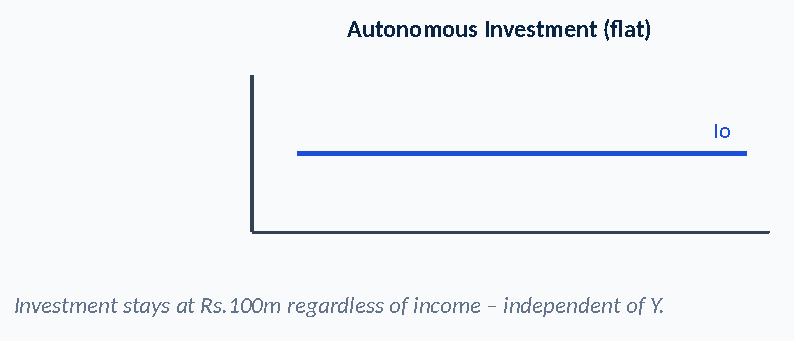
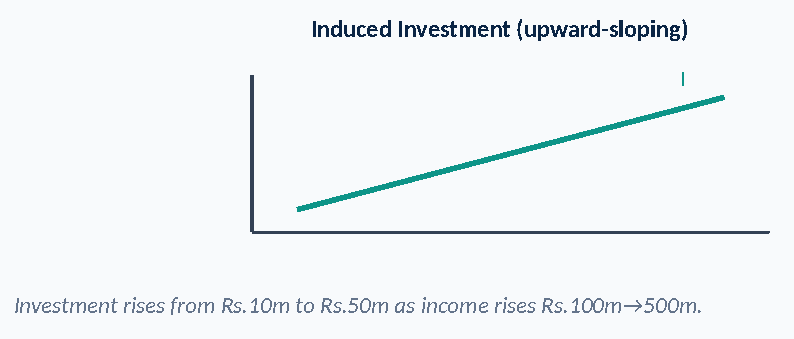
Determinants of Investment (Keynes' Two Core Factors)
🔍MARGINAL EFFICIENCY OF CAPITAL (MEC)
- Expected rate of return on a new investment
- Downward-sloping MEC curve: inverse relation between MEC and level of investment
MARKET RATE OF INTEREST
- Cost of borrowed funds (% of principal)
- Assumed constant in the short run – so MEC drives investment decisions
Investment rule: a rational investor proceeds only when MEC > Market Rate of Interest. Example: Zain expects 6% return, interest is 4% → profitable (invests). If interest rises to 8% > 6% MEC → investment becomes a LOSS → he withdraws/deposits funds instead.
Why MEC Curve Slopes Downward
📈Investment ↑
Demand for capital goods ↑ → their cost (supply price) ↑
MEC falls as investment rises
Investment ↑
Product market supply ↑ → product prices ↓
Expected return (MEC) falls further
Factors Shifting the MEC Schedule
📊Optimistic business sentiment
MEC ↑ (shifts right)
Wage rates ↑
Cost of production ↑ → MEC ↓ (shifts left)
Entrepreneurs' income ↑ (e.g. tax concession)
More opportunity to invest → MEC ↑
Population growth ↑
Future demand ↑ → MEC ↑
Many substitute capital goods already exist
MEC ↓ (less advantageous to invest)
Tax rates ↑
Profitability ↓ → MEC ↓
Government Means of Influencing Investment
📌CONTROL INTEREST RATES
- Low rates encourage investment; rising rates discourage it
DIRECT ENCOURAGEMENT
- Investment grants, lower cost of doing business, tax incentives, rule of law
STIMULATE CONFIDENCE
- Stable, consistent economic policy (avoid sudden changes)
ENCOURAGE TECHNOLOGY
- Finance R&D, invest in education
INFLUENCE CONSUMPTION
- Control money supply/credit → affects consumer spending & (via accelerator) investment
GOVERNMENT SPENDING
- Infrastructure spending creates demand that stimulates private investment
Exam Patterns & MCQ Quick Clues
🎯"C = Co + cY, given a slope value"
Slope = MPC (marginal propensity to consume)
"Income zero, but spending is positive"
Autonomous consumption / dissaving
"Investment curve is horizontal / flat"
Autonomous investment
"MEC > market rate of interest"
Investment is profitable – proceed
"MPC + MPS = ?"
Always equals 1
"Buying an old/used capital asset"
NOT real investment (no net addition to capital stock)
⚠ ECONOMICS EXAM TRAPS
Trap: Confusing MPC (change in consumption/change in income) with APC (total consumption/total income) – APC falls with income even while MPC stays constant.
Trap: Treating purchase of a SECOND-HAND/used asset as real investment – it is merely a transfer of ownership, not new capital formation.
Trap: Mixing up autonomous investment (flat curve, income-independent) with autonomous consumption (income-independent spending floor) – both are "autonomous" but apply to different functions.
Trap: Forgetting MEC is a downward-sloping curve – a common error is drawing it upward sloping like a normal supply curve.
Trap: Assuming MPC/MPS can be outside 0 and 1 – by Keynes' law both must lie strictly between 0 and 1.
Complete Chapter Decision Tree
📌QUESTION GIVEN → Consumption, Saving, or Investment question? → Identify given values (Co/So/Io, c/s/m, Y) → Select relevant formula (C=Co+cY / S=−So+sY / I=Io+mY) → Calculate MPC/APC or MPS/APS or compare MEC vs interest rate → Check MPC+MPS=1 if relevant → Interpret & select final answer
PRC-3 ECONOMICS – CHAPTER 6 IN 60 SECONDS
- Consumption function: C = Co + cY; MPC = ΔC/ΔY; APC = C/Y.
- Keynes' law: consumption rises with income, but less than proportionately (0<MPC<1).
- Saving function: S = −So + sY; MPS = ΔS/ΔY; APS = S/Y.
- MPC + MPS = 1 always (since Y = C+S).
- Investment function: I = Io + mY.
- Autonomous investment: flat curve, income-independent. Induced investment: upward-sloping, income-dependent.
- Real investment = new capital goods only; buying used assets is NOT investment.
- Investment determinants: MEC (downward-sloping) and market interest rate.
- Invest only if MEC > interest rate.
- Govt. tools: interest rates, grants/tax incentives, confidence, R&D, credit control, public spending.
Chapter Memory Map
🧠Preparing for ICAP PRC-3?
Join Learning League for chapter-wise classes, practice MCQs and tests on our student portal. Message us on WhatsApp to enrol.