Chapter Roadmap
🧭BANKS & THEIR FUNCTIONS
CENTRAL BANK & MONETARY POLICY (instruments & objectives)
CONTRACTIONARY VS EXPANSIONARY POLICY
LIMITATIONS & ROLE OF SBP
Theme: banks evolved from goldsmiths' receipts into today's formal system, with commercial banks creating credit and the central bank overseeing the whole system. Monetary policy is the central bank's key tool – manipulating money supply and interest rates via quantitative and qualitative instruments to hit macroeconomic objectives.
Key Definitions
📘Bank
A financial institute licensed by the government to receive deposits, which it then invests in a number of securities.
Financial Intermediary
A financial institution through which savers can indirectly provide funds to borrowers.
Central Bank
The state institution authorized to provide banking/financial services to commercial banks and government; implements state policy and controls currency issuance & circulation.
Credit
A contractual agreement whereby a borrower receives something of value in the present, in exchange for payment in the future, generally with interest.
Credit Creation
Process by which a commercial bank increases the supply of money through creation of new deposits in the name of borrowers.
Monetary Policy
Measures taken by the central bank to influence macroeconomic activity, especially by manoeuvring money supply and credit through changing interest rates.
Open Market Operations (OMOs)
Buying or selling government securities in the open market to change the level of reserves held by commercial banks.
Expansionary vs Contractionary Monetary Policy
Expansionary: used to STIMULATE demand. Contractionary: used to REDUCE demand.
Functions of Commercial Banks
⚙️RECEIVING DEPOSITS
- Primary function; public earns interest on surplus funds
ADVANCING LOANS
- Deposits are a liability; loans issued against interest
DISCOUNTING BILLS OF EXCHANGE
- Bank pays seller early against a bill, deducting a discount
LOCKERS FACILITY
- Safekeeping of valuables for a nominal fee
CREDIT CREATION
- Generates further loanable funds from deposits (see p.4)
Functions of the Central Bank
⚙️Note Issuance
Sole authority to issue & maintain currency supply.
Fixed Fiduciary: notes issued up to a limit need no backing; beyond it, 100% reserves required.
Proportional Reserve: a fixed % (Pakistan: 30–40%) of gold/silver/forex must back all notes issued.
Banker to the Government
Advises & funds government projects, like a commercial bank does for customers.
Banker to the Banks
Holds commercial banks' cash reserves centrally – builds confidence & buffers financial shocks; offers counselling in difficulty.
Lender of Last Resort
Provides liquidity to commercial banks unable to meet requirements elsewhere – protects savers' deposits.
Exchange Rate Controls
Uses forex & gold reserves to manage exchange rates and balance of payments.
Clearing Agent
Commercial banks hold accounts with the central bank, reducing need to physically issue/transfer cash between banks.
CUSTODIAN OF MONETARY RESERVES
- Holds/safeguards gold & foreign currency reserves for the country
Instruments of Monetary Policy: Quantitative Controls
🏛1. BANK RATE (DISCOUNT RATE)
- Rate at which the central bank rediscounts bills of exchange / lends to commercial banks
BANK RATE ↑
BORROWING COST ↑
LOANABLE FUNDS ↓
MONEY SUPPLY TIGHTENS
INTEREST RATE ↑ ⇒ AD ↓ ⇒
INFLATION CONTROLLED
2. OPEN MARKET OPERATIONS (OMOS) – EXAMPLE: SELLING RS.1BN IN BONDS
CENTRAL BANK SELLS SECURITIES
BOUGHT BY COMMERCIAL BANKS
COMMERCIAL BANK RESERVES ↓
TIGHT MONEY SUPPLY
INTEREST RATE ↑ ⇒ AD ↓ ⇒
INFLATION CONTROLLED
3. CHANGES IN RESERVE REQUIREMENT
RESERVE RATIO ↑
ABILITY TO LOAN OUT ↓
TIGHT MONEY SUPPLY
INTEREST RATE ↑
INVESTMENT ↓ ⇒ AD ↓ ⇒
INFLATION CONTROLLED
4. CREDIT RATIONING
- Central bank fixes the MAXIMUM limit of loans commercial banks may issue – adjusting this limit controls money supply
Instruments of Monetary Policy: Qualitative Controls
🏛CHANGES IN MARGINAL REQUIREMENT
- Gap between security value demanded and loan actually issued – adjusting it controls credit
MORAL PERSUASION
- Central bank personally discusses with/persuades banks against risky actions
DIRECT ACTION
- Severe measure for non-cooperative banks: fines, refused discount facility, altered bank rate
SPECIAL DEPOSIT
- Attractive short-term deposit offered to banks – withdraws money from the market
PRUDENTIAL CONTROL
- Regulations/articles on credit volume issued by the central bank
Quantitative vs Qualitative Controls
⚖️| Quantitative Controls | Qualitative Controls | |
|---|---|---|
| Target | Overall VOLUME/level of credit & money supply | DIRECTION/composition & behaviour of credit |
| Examples | Bank rate, OMOs, reserve requirement, credit rationing | Marginal requirement, moral persuasion, direct action, special deposits, prudential control |
Credit Multiplier (Money Multiplier)
💵CREDIT/MONEY MULTIPLIER
Credit Multiplier = 1 ÷ Reserve Ratio | Total Credit Created = Initial Deposit × Credit Multiplier
The credit multiplier is the RECIPROCAL of the reserve ratio
Worked example: Reserve ratio = 40%; Initial deposit = Rs.10,000 ⇒ Credit Multiplier = 1÷0.4 = 2.5 ⇒ Total Credit Created = 10,000×2.5 = Rs.25,000.
Exam clue: a LOWER reserve ratio means a LARGER credit multiplier (more deposits can be created from the same initial deposit) – and vice versa.
Objectives of Monetary Policy
🏛OBJECTIVES OF MONETARY POLICY
Inflation
Keep it low & steady for stable economic performance
Economic Growth
Develop overall per-capita income
Exchange Rate Stability
Stable rates via balance-of-payments management
Full Employment
Increase production/demand so resources are fully utilised
Credit Control
Ensure fair credit issuance, protecting vulnerable groups
Current Account Correction
Correct BoP/current account deficit via interest rate changes (esp. on bonds)
Conflicts Between Monetary Policy Objectives
🏛Policy to boost full employment (AD↑)
Drives up inflation – conflicts with PRICE STABILITY
Policy to boost growth via exchange-rate manipulation (favour exports)
Jeopardises EXCHANGE RATE STABILITY
Policy to boost growth via credit expansion
Raises risk of credit default – conflicts with CREDIT CONTROL
Exam clue: the source is explicit that NOT ALL monetary policy objectives can be achieved simultaneously – some trade-offs are unavoidable.
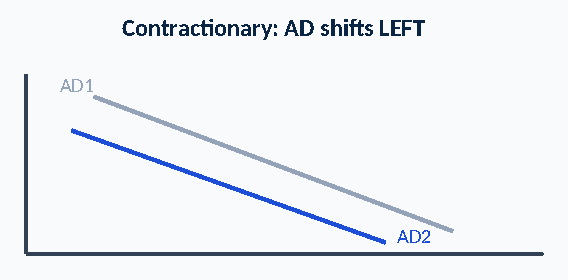
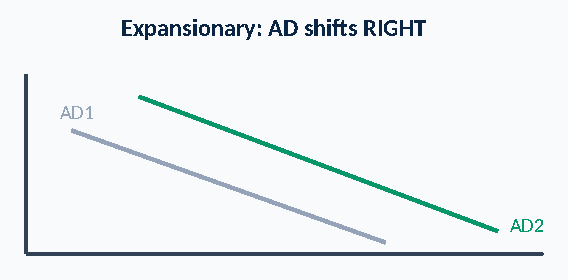
Contractionary vs Expansionary Monetary Policy
⚖️| Contractionary (Anti-Inflationary) | Expansionary (Anti-Deflationary) | |
|---|---|---|
| Central bank action | Raises interest rate / raises reserve requirement | Buys government bonds from commercial banks |
| Effect on reserves | Commercial bank reserves EFFECTIVELY reduced | Commercial bank cash reserves ↑ |
| Bank response | Reduce loans issued / raise borrowing cost | Loan out additional reserves (multiplied across banks) |
| Effect on consumption/investment | Both FALL (disposable income ↓, investment disincentivised) | Both RISE (lower market interest rate) |
| Effect on AD | Decreases | Increases |
| Effect on Output & Price | Output falls Y1→Y2; Price falls P1→P2 | Output rises Y1→Y2; Price rises P1→P2 |
Limitations of Monetary Policy
🏛- Non-monetary sector: in developing countries, barter-reliant groups don't use banks – policy can't reach them
- Non-banking financial institutions: offer credit but fall outside central bank supervision
- High liquidity in financial markets: agents can create their own liquidity, blunting a tightening policy
- Time lags: effects take time to materialise, forcing the central bank to predict an uncertain future
- Lack of coordination with fiscal policy: central bank (monetary) and government (fiscal) working at cross purposes undermines effectiveness
Role of the State Bank of Pakistan (SBP)
🏦CORE ROLES
- Prepares Pakistan's monetary policy
- Organizes/manages the entire banking & financial system
- Controls foreign reserves, currency rate & currency supply
- Controls inflation via open market operations (currency circulation, interest rate, forex rate, bank loans)
INSTITUTIONS & INITIATIVES
- NBP (National Bank of Pakistan): largest commercial bank, SBP's treasury agent
- ZTB (Zarai Taraqiyati Bank) & IDBP: soft loans for agriculture & industry development
- Promotes Islamic banking (separate deposit counters)
- Supports exporters (easy remittances, incentives); discourages unnecessary imports (esp. luxury goods)
Exam Patterns & MCQ Quick Clues
🎯"Rediscounting bills of exchange"
Bank Rate
"Buying/selling govt. securities in open market"
Open Market Operations
"Central bank personally discourages a bank's action"
Moral Persuasion (qualitative control)
"Reserve ratio given + initial deposit"
Credit Multiplier = 1÷Reserve Ratio
"Central bank raises interest rate/reserve requirement"
Contractionary Monetary Policy
"Central bank buys bonds from commercial banks"
Expansionary Monetary Policy
⚠ ECONOMICS EXAM TRAPS
Trap: Confusing Quantitative controls (volume of credit: bank rate, OMOs, reserve requirement) with Qualitative controls (direction/behaviour: moral persuasion, direct action).
Trap: Mixing up Fixed Fiduciary System (fixed limit, then 100% backed) with Proportional Reserve System (ongoing % backing, used in Pakistan).
Trap: Assuming all monetary policy objectives can be met at once – the source explicitly notes conflicts exist (e.g. full employment vs price stability).
Trap: Reversing contractionary vs expansionary effects on reserves – contractionary REDUCES commercial bank reserves/lending; expansionary INCREASES them.
Trap: Forgetting the credit multiplier is the RECIPROCAL of the reserve ratio, not the ratio itself.
Complete Chapter Decision Tree
📌QUESTION GIVEN → Bank function, central bank function, monetary policy instrument, or contractionary/expansionary question? → Identify specific concept (which instrument/function/objective) → If numerical: apply credit multiplier formula → Trace the cause-effect chain (rate/reserve change → money supply → interest rate → AD) → Interpret & select final answer
PRC-3 ECONOMICS – CHAPTER 11 IN 60 SECONDS
- Bank: licensed to receive deposits & invest funds; functions include deposits, loans, bill discounting, lockers, credit creation.
- Central bank functions: note issuance, banker to govt/banks, lender of last resort, exchange control, clearing agent, custodian of reserves.
- Quantitative controls: bank rate, OMOs, reserve requirement, credit rationing.
- Qualitative controls: marginal requirement, moral persuasion, direct action, special deposit, prudential control.
- Credit multiplier = 1/Reserve Ratio; Total Credit = Deposit × Multiplier.
- 6 objectives: inflation, growth, exchange rate stability, full employment, credit control, current account correction – not all achievable together.
- Contractionary: rate/reserve ↑ → AD↓ → output & price fall. Expansionary: reverse.
- Limitations: non-monetary sector, non-bank institutions, high liquidity, time lags, poor fiscal coordination.
- SBP: Pakistan's central bank – monetary policy, reserves, inflation control, NBP/ZTB/IDBP, Islamic banking.
Chapter Memory Map
🧠Preparing for ICAP PRC-3?
Join Learning League for chapter-wise classes, practice MCQs and tests on our student portal. Message us on WhatsApp to enrol.