Chapter Overview — the Hr Roadmap
🧭CENTRAL IDEA HRM is a key function that helps an organisation achieve its strategic goals and objectives by creating a strategy for meeting current and future human resource needs. Success depends on the skills and experience of its human resources.
AREA 1
HRM Overview Strategy objective · HR planning · Job analysis
›
AREA 2
Recruitment Obtain a supply of suitable candidates
›
AREA 3
Selection Choose the most suitable candidate
›
AREA 4
Training & Development Build skills & experience
›
AREA 5
Employee Retention Reduce turnover · keep talent
Key elements of the HRM function in this chapter: Strategy & planning Job analysis & description Recruitment & selection process
Training & development Compensation & benefits Retention strategies
Key Definitions
📘Teal terms = high exam priority
One of the four traditional factors of production; the economic contributions of people working with their minds and body.
A forecast of HR required at a future time + plans to ensure the required numbers and skills are available. Typically looks 3–5 years ahead.
Observation & study of pertinent information about a job: its tasks, the knowledge, skills & abilities needed, and the environment of work.
A formal account of a job, its purpose and scope, and the formal duties and responsibilities of the jobholder.
Describes the qualifications and skills needed for a job — education, experience, personal and physical characteristics.
A specification of the qualities needed from the individual who will perform the job.
Starts when a job vacancy is identified; the process of obtaining a supply of suitable candidates to fill the vacancy.
Appointing the most suitable candidate to a vacancy by choosing the best individual from the candidates available.
A process in which individuals are taught something specific; has a particular objective (theoretical/practical knowledge, new information or skills).
Learning through experience and performing work that augments an employee’s skill set and prepares him/her for growth.
Learning a job at the actual work site in real-life situations (not simulated), under a qualified worker/instructor. Also called job instruction training.
Training conducted in a location specifically designated for training — near the workplace or away (training centre / resort).
Encouraging employees to remain with the organisation as long as possible, ideally until completion of a project.
Occurs when employees leave voluntarily or are dismissed — i.e. staff leaving the job.
Core Concept — Objective of Human Resource Strategy
📌RESPONSIBILITY 1 · NOW
Assess current HR Quantity & quality available —
strength and skills
›
RESPONSIBILITY 2 · FUTURE
Estimate future HR needs Quantity & quality needed —
numbers and skills
›
RESPONSIBILITY 3 · GAP
‘Fill the gap’ Ensure the entity has the HR it needs
›
KEY OBJECTIVE
HR available, as required Right numbers + right skills
SURPLUS / DECLINING SKILLS It may also be necessary to reduce employees whose skills are declining in importance through
redundancy
re-training
relocation
⚠ WHY IT MATTERS A critical success factor may be having sufficient
HR with the necessary skills. Without the key skills, it might be
impossible to develop the business successfully.
Human Resource Planning
📌HR PLAN = FORECAST + PLANS Forecast of HR required at a given future time + plans to ensure the required numbers & skills are available.
3–5 YEARS
typical planning horizon
Beyond 5 years → difficult to forecast with any accuracy or reliability.
AREAS COVERED BY AN HR PLAN (9)
- Job analysis and design
- HR requirements — skills and strength
- Recruitment of new staff
- Training & development to improve skills
- Performance appraisal — monitor & control skill development
- Promotion and rewards
- Motivation strategy
- Redundancies (employees surplus to requirements)
- Re-training
ENVIRONMENTAL FACTORS — plans must be REALISTIC
- Population trends & total work-force size in each country of operation
- Government policy — e.g. change in retirement age
- Educational system — students progressing from elementary school to college/university
- Availability of individuals trained in a particular skill/vocation
- Changing employment patterns — more part-time / home-based workers
- Competition for highly skilled HR (e.g. programmers)
- Trends in sub-contracting & outsourcing
- Trends in IT & technological change affecting labour needs
Job Analysis — the Foundation of Hr Activities
📌WHAT JOB ANALYSIS STUDIES
TASKS
specific tasks that comprise the job
KSAs
knowledge, skills &
abilities to perform it
ENVIRONMENT
in which the job is performed
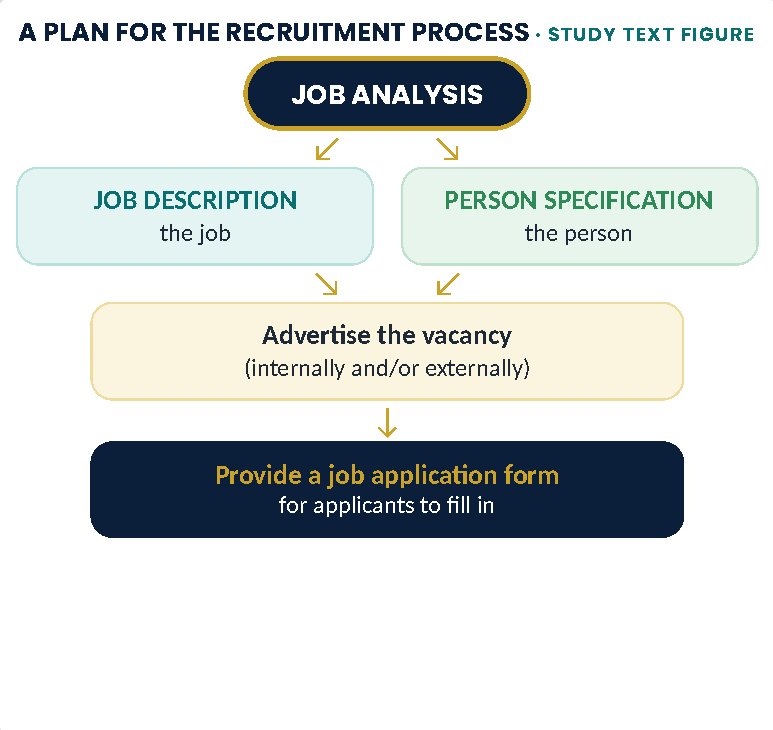
Managers use this information to develop job descriptions and job specifications.
JOB ANALYSIS IS THE BASIS FOR…
Defining the scope of jobs
Writing job descriptions
Performance appraisals
Selecting & promoting staff
Training needs assessment
Compensation
Organisational planning
PURPOSE (2 OUTPUTS) ① a detailed specification of the job → ‘job description’ ② a specification of the qualities needed from the individual → ‘person specification’
Comparison — Job Description vs Job Specification
⚖️| Basis | JOB DESCRIPTION | JOB SPECIFICATION |
|---|---|---|
| Focus | The JOB — what is to be done | The PERSON — what qualifications & skills are needed |
| Meaning | Formal, written explanation of a specific job; a formal account of its purpose, scope, duties & responsibilities | Describes the qualifications and skills necessary for a specific job |
| Typical contents | Job title · tasks (e.g. receiving customers at the front desk) · relationships with other jobs · reporting lines · physical & mental skills required (e.g. communication with sales staff, daily MIS reporting) · duties · responsibilities · working conditions · + position in hierarchy (e.g. AVP, VP) & range of annual remuneration | Education (some jobs require a college degree) · Experience · Personal characteristics (e.g. adverts request outgoing, hardworking individuals) · Physical characteristics |
| Exam clue | “duties”, “reporting line”, “tasks”, “working conditions” | “degree”, “experience”, “hardworking”, “physical characteristics” |
Recruitment — Why & How
📌WHY WORKFORCE CHANGES OCCUR (CAUSE)
- Employees leave — job elsewhere or retirement
- Skilled staff moved to other jobs internally to use developing talent
- Labour requirements change — new skills needed, old skills not required → new recruits; some staff made redundant
EFFECT → manage change to stay efficient & effective: fill vacancies with suitable people.
RECRUITMENT Starts when a job vacancy is identified. The process of obtaining a supply of suitable candidates to fill the vacancy.
Employees are extremely valuable assets — efficiency & effectiveness depend on their skills and abilities.
ADVERTISING A VACANCY Jobs must be brought to the attention of those who might apply:
1 Internally — existing employees 2 Externally — people outside 3 Both internally & externally
The 5-stage Recruitment & Selection Process
📌Study Text figure
RECRUITMENT = STAGES 1–3
STAGE 1
Agree the vacancy to be filled
›
STAGE 2
Identify the skills needed for the job
›
STAGE 3
Obtain applicants for the job vacancy
›
SELECTION = STAGES 4–5
STAGE 4
Select candidates for interviews / short-listing
›
STAGE 5
Selection interviews: offer job to selected candidate
Recruitment vs Selection
⚖️| Basis | RECRUITMENT | SELECTION |
|---|---|---|
| Concerned with | QUANTITY — getting candidates to apply for job vacancies | QUALITY — choosing the individual who seems best for the job |
| Meaning | Obtaining a supply of suitable candidates to fill the vacancy | Collecting information about applicants and using it to decide which ones to hire — application, interviewing, testing, reference checking to filter the recruitment pool |
| Starts / ends | Starts when a job vacancy is identified | Ends with an offer of employment and its acceptance |
Selection — 7 Steps / Hurdles
📌1
Initial Screening — application form and/or résumé + brief interview of 30 minutes or less. Covers education, previous experience, duties performed. Remuneration expectations discussed to avoid wasting time & effort.
2
Employment Tests — Ability & performance tests → does the applicant have the skills? Aptitude, IQ, technical or personality tests → potential for a kind of work & ability to fit the organisation’s culture. Assess: cognitive ability (learn, adapt, solve problems) · motivation potential (attitude, behaviour, productivity) · knowledge & skills (math, verbal, data entry, software).
3
Selection Interview MOST WIDELY USED TOOL — in-depth discussion of experience, skills, education & career interests. Managerial/professional posts → several interviewers incl. the line manager. Determines communication skills & motivation; may use realistic job situations (e.g. dealing with a disgruntled customer).
4
Background & Reference Check — after passing the interview: legal history, reasons for leaving previous jobs, creditworthiness (credit check), general conduct → job suitability.
5
Physical & Medical Exams — physically able to perform tasks; airline industry / law enforcement emphasise physical fitness & mental agility; medical tests (incl. drug test for certain jobs) to minimise medical insurance risks & productivity issues.
6
Decision to Hire — top candidate selected & offered the job; other qualified applicants considered if the top one declines. Offer may be contingent on physical/medical tests. The new employee’s manager plays a major role in the final decision.
7
Offer of Employment — process ends with the offer and its acceptance. Keep a ranked short-list — if the top candidate refuses, offer the next. Confirm & accept in writing; legislation may require a formal written contract.
Training vs Development
⚖️| Basis | TRAINING | DEVELOPMENT |
|---|---|---|
| Meaning | A process in which individuals are taught something specific | Learning through experience and performing work that augments skills & prepares for growth |
| Focus | A particular objective — theoretical/practical knowledge, new information or skills related to work | Greater experience & responsibilities — NOT primarily teaching how to perform a specific task |
| How achieved | Formal courses, CBT, workplace training, induction; on-the-job / off-the-job methods | Different tasks, new experiences, extra responsibilities, opportunities to use own initiative → career advancement |
| In the workplace | Workplace training → technical or practical skills | Workplace development → experience & personal skills (management, leadership) |
| Commonly for | Employees at different levels | Commonly associated with managers → better managers, able to progress to senior positions |
BENEFIT Organisations benefit because T&D produces a better work force — there should be T&D programmes for employees at different levels.
Tools of Training — 4 Categories
📌① Formal training In a training-room environment:
- In-house — all trainees from the same organisation (in Pakistan, commonly delivered by colleagues)
- External — external trainer/firm; trainees from different organisations
② Computer-based
training (CBT)
- Trainees work at their own pace from a computer package
- Highly interactive
- Integrates learning components with short, frequent tests
③ Training in the work
place
- A method of developing individuals as well as training
- Training → technical/practical skills
- Development → experience & personal skills (management, leadership)
④ Induction
- In-house training by the organisation’s own trainers & experts, or by a hired external trainer/firm
- Formal training may end with an examination → qualification/certificate
On-the-job vs Off-the-job Training
⚖️ON-THE-JOB TRAINING MOST COMMONLY USED At the actual work site in real-life situations — not simulated a.k.a. job instruction training; placed on a regular job & taught the skills Under supervision of a qualified worker or instructor Advantage: ✓ first-hand knowledge & experience under actual working conditions Methods include: job rotation · coaching · mentoring · cross-functional team assignments
Types:
Orientation Coaching Mentoring Job instruction manuals
Apprenticeships Work shadowing
OFF-THE-JOB TRAINING In a location specifically designated for training — near workplace or away (special training centre / resort) Advantage: minimises distractions → full attention to the material Advantage: provides special tools/facilities not available at the workplace Organisations may invest in own training centres — e.g. new banking trainees attend an intensive course at a national training institute before starting work
Avenues:
Classroom lectures & courses Audio-visual films & presentations
Seminars
Simulation centres
Game theory sessions
Case study sessions Team-building Programmed instruction
Online courses
Tools of Development
📌WHAT DEVELOPMENT DOES Improves skills, knowledge & abilities through real work experience → greater experience & responsibilities → a more valuable resource (employee).
UNLIKE ON-THE-JOB TRAINING… Development is not primarily concerned with teaching how to perform a specific task or job.
EXAMPLES · SELF-TEST Q12
Both
Secondment
and
Delegation
are tools of development.
Employee Retention & Turnover — Cause → Effect
🔁FAILING TO RETAIN = COSTLY After heavy investment in recruitment, selection & development, losing staff leads to:
- Insecure co-workers
- Increased workloads
- Time to recruit, hire & train new staff
Retention benefits both the organisation and the employees.
EMPLOYEE TURNOVER Employeesleave voluntarily or are dismissed→ results in:
Lost productivity
Recruitment costs
T&D expenses
Socialisation costs
Some turnover is inevitable — retirement, promotions, death → aim to optimise turnover rates.
HIGH TURNOVER MAY INDICATE ISSUES WITH
Selection Training
Compensation Work environment
To reduce turnover: job enrichment · greater job flexibility · improved employee benefits. Understand why employees leave first.
Why Employees Leave
📌PERSONAL — beyond employer’s control Family relocation · caregiving responsibilities · career change · higher education · desire for higher salary
INFLUENCED BY THE EMPLOYER Workplace culture · employee’s perception of their role · opportunities for growth & development
KEY TURNOVER FACTORS (7)
- Poor relationships with Personal & family supervisors & co-issues workers End of a fixed-term
- Unchallenging, contract monotonous, Financial instability of repetitive tasks the organisation
- Financial concerns Lack of flexible work hours
Employee Retention Strategies (8)
📌Go beyond a good pay cheque → long-term commitment
1 Well-defined career
path Clear growth — vertical & lateral; variety of experiences keeps employees engaged.
2 Compensation
Critical factor — the largest part of the retention process. Package must be attractive & competitive (expectations vary across industries). Components below.
3 Work relationships
Managers: fair, flexible, recognise contributions, support career development. Strong co-worker ties → less turnover.
4 Job and work-life
Job security ↓ (downsizing, layoffs, mergers) → anxiety → loyalty ↓. Higher security → better retention. Job design: skill mismatch (over-/under-qualified), stressful workload, schedule timing, location → burnout.
5 Work-life balance
Flexible hours, work-from-home policies (respecting core office culture), occasional WFH days, ‘ME time’ for hobbies.
6 Organisational
environment Manage people well → retention takes care of itself. People want: appreciation, ample growth,
friendly & cooperative environment, organisation as a ‘second home’.
7 Recognition &
feedback Appreciate efforts even when things go smoothly; highlight impactful outcomes; timely feedback; also obtain feedback from employees.
8 Transparent & fair
reviews Rewards based on merit; celebrate milestones; achievements, strengths & development areas → mutually agreed goal setting.
COMPENSATION PACKAGE — 7 COMPONENTS ① Salary / monthly wage — largest ② Bonus — year-end or festivals; additional component, most compared; reflects skill & reward for performance experience; regular performance-based increases
③ Economic benefits — paid holidays, ④ Long-term incentives — stock travel concessions, other financial benefits options/grants, esp. in startups, to stay longer
⑤ Health insurance — financial security & ⑥ Post-retirement benefits — gratuity, EPF, peace of mind for employee & family other retirement payments ⑦ Miscellaneous — employee assistance programmes (psychological counselling, legal aid), discounts on company products, use of company assets (e.g. cars)
ORGANISATIONAL ENVIRONMENT INCLUDES
Culture Values Company reputation
Quality of people
Employee development & career growth
Encouragement of risk taking
Use of leading technologies Trust
Motivation — the Retention Engine
📌DRIVERS
Recognition · rewards · development · work-life balance
›
MOTIVATION IMPACTS
Job satisfaction · engagement · loyalty
›
HOW IT REDUCES TURNOVER
Positive environment · career growth · prevents burnout
›
OUTCOME
Engaged, productive employees who stay long-term
Business Application — Concept Situation Application
📌Situations taken from the Study Text
| Concept | Business situation | Application / exam link |
|---|---|---|
| Job description | A task such as receiving customers at the front desk; skills like daily MIS reporting | Written into the job description (tasks / skills required) |
| HR planning — environmental factor | Strong competition for programmers; a change in the retirement age | Competition for skilled HR / government policy → plan must stay realistic |
| Selection interview | Applicant asked how they would handle a disgruntled customer | Realistic job situation → tests communication skills & motivation |
| Physical & medical exams | Hiring for the airline industry or law enforcement | Greater emphasis on physical fitness & mental agility |
| Off-the-job training | New banking trainees attend an intensive course at a national training institute | Designated training location before starting actual work |
| Compensation — long-term incentive | A startup grants stock options | Incentivises employees to stay longer & contribute to growth |
How This Chapter Can Be Tested
📌1 Definition-based — recruitment, selection, training, development, job analysis, turnover
2 Concept identification — scenario clue → HR activity (e.g. credit check → selection)
3 Classification — on-the-job types vs off-the-job avenues; recruitment vs selection stages
4 “Which is NOT…” — HR plan areas, HR responsibilities, training tools, package items
5 Sequence / process — 5 recruitment & selection stages; 7 selection hurdles 6 Comparison — recruitment vs selection; training vs development; JD vs job spec
7 Cause → effect — why staff leave; what high turnover indicates; motivation 8 Key facts — 3–5 year horizon · screening interview ≤30 min · ‘realistic’ plans → retention
Exam Traps
⚠️1 Short-listing is part of… — ✗ Recruitment ✓ Selection (Stage 4). Recruitment = stages 1–3 only.
2 Quantity vs quality — Recruitment = quantity (getting applicants); Selection = quality (choosing the best). Don’t reverse them.
3 Job description ≠ Job specification — JD = the job (duties, reporting lines); job/person spec = the person (education, experience).
4 Credit check — A background & reference check → a selection step, not recruitment.
5 HR plan horizon — 3–5 years. Beyond 5 years forecasts lose accuracy & reliability. Not 3–7, not <3.
6 ‘Realistic’ — HR plans must be realistic → so they consider environmental factors.
7 Simulation — Simulation centres are OFF-the-job. On-the-job = actual work site, not simulated.
8 Training vs development — Development is not teaching a specific task — it gives experience & responsibility.
9 Turnover meaning — Employee turnover = staff leaving (voluntary or dismissed) — not sales/revenue turnover.
10 Not an HR responsibility — ‘Encouraging low performers to leave’ is not one. Declining skills → redundancy/re-training/relocation.
11 Annual package — Appraisals are not part of the compensation package (bonus, EPF, travel concessions are).
12 Who is covered? — Human resources cover both full-time and part-time employees.
13 Most widely used — Selection interview = most widely used hiring tool; on-the-job = most commonly used training method.
14 Largest component — Compensation = largest part of retention; salary/wage = largest part of compensation.
Chapter Decision Tree — Which Hr Concept IS Being Tested?
📌① READ THE SCENARIO
KEY CLUE IN THE QUESTION
CONCEPT TESTED
Forecast of numbers & skills; 3–5 years; population, retirement age, outsourcing
›
HR PLANNING
② FIND THE KEY CLUE
match it in the clue table →
Tasks, KSAs, work environment; duties, reporting lines vs education, experience, traits
›
JOB ANALYSIS → JD / PERSON SPEC
↓
③ SELECT THE CONCEPT
Vacancy identified; skills identified; advertise internally/externally; obtain applicants
›
RECRUITMENT (Stages 1–3)
↓
④ CHECK THE CONDITION
- Job or person?
- Quantity or quality?
- Actual site or designated location?
- Specific task or experience?
- Personal or employer-influenced reason?
Short-listing; résumé screening; tests; interview; credit/reference check; medical; offer
›
SELECTION (Stages 4–5 / 7 hurdles)
Taught something specific; actual work site; coaching, apprenticeship, work shadowing
›
ON-THE-JOB TRAINING
Designated location; seminars, simulation, case studies, online courses
›
OFF-THE-JOB TRAINING
Experience & responsibility; managers; secondment, delegation; career advancement
DEVELOPMENT
⑤ FINAL ANSWER
›
Staff leaving; turnover costs; career path, compensation, work-life balance, reviews
›
RETENTION / TURNOVER
Quick Memory Map
🧠| Concept | Key words | Core idea |
|---|---|---|
| HR strategy | assess · estimate · fill the gap | HR available, as required |
| HR plan | forecast · 3–5 yrs · realistic | right numbers & skills in future |
| Job analysis | tasks · KSAs · environment | job description + person specification |
| Recruitment | vacancy · skills · applicants | QUANTITY of candidates |
| Selection | screen · test · interview · check · offer | QUALITY — the best candidate |
| Training | specific · objective · on/off-the-job | skills for the job |
| Development | experience · responsibility · managers | growth & career progression |
| Retention | turnover · compensation · environment · motivation | keep talent long-term |
MNEMONIC — 7 SELECTION HURDLES
“I Eat Sweet Biscuits, Please Don’t Object”
I Initial screening E Employment tests S Selection interview B Background & reference check P Physical & medical exams D Decision to hire O Offer of employment Memory aid only — the sequence is from the Study Text.
Business — Human Resource Strategies in 60 Seconds
⚡⏱ PLAN & ANALYSE
- HR = labour, a factor of production
- Objective: HR available, as required
- Assess now → estimate future → fill the gap
- HR plan: forecast, 3–5 yrs, realistic
- Job analysis → JD (job) + person spec (person)
⏱ HIRE & BUILD
- Recruitment = quantity (stages 1–3)
- Selection = quality (stages 4–5; 7 hurdles)
- Interview = most widely used tool
- Training = specific; development = experience
- On-the-job = actual site; off-the-job = designated place
⏱ KEEP & MOTIVATE
- Turnover = staff leaving (voluntary/dismissed)
- High turnover → selection, training, pay, environment issues
- 8 retention strategies; compensation is largest part
- Salary = largest pay component
- Motivation → satisfaction, engagement, loyalty
Test yourself on this chapter
Practice 100 MCQs per chapter with answers – Chapter 1 is free for everyone. Enrol on WhatsApp for all 8 chapters, classes and tests on our student portal.