Chapter Overview — the Roadmap
🧭CENTRAL IDEA A formal structure — whether traditional or contemporary — brings order, discipline and control to decision-making and shapes the organisation, whether tall or flat. It rests on key elements such as specialisation, levels of management, chain of command and spans of control.
AREA 1
Organisational structures Purpose & importance
›
AREA 2
Types of structure Entrepreneurial · functional · divisional · matrix · virtual
›
AREA 3
Globalisation MNOs · emerging markets
›
AREA 4
Key elements of structure 6 building blocks → tall vs flat
Key Definitions
📘Teal terms = high exam priority
The formal arrangement defining how activities & tasks are divided and how processes & information flow, to achieve organisational goals.
An entity managed directly by its entrepreneurial owner, who takes all key decisions.
Groups together people with similar skills performing related tasks.
Large company split into relatively autonomous divisions — by product, customer, process or geography.
Employs a multiple command system with support mechanisms, culture & behaviour pattern (Davis & Lawrence 1977); dual reporting.
No identifiable physical existence — may have no head office, premises, employees or assets; run via IT & outsourcing partners.
The increasing integration of economies, cultures and markets across the world.
A corporation that operates in more than one country.
Economies transitioning from developing to developed status.
How activities and people are grouped into units
on
— the framework for coordinating jobs.
An unbroken line of authority from the top (e.g. CEO) to the bottom; clarifies who reports to whom.
The number of subordinates a superior can effectively manage.
The hierarchy of authority — how responsibilities are distributed across layers.
Decision-making power concentrated at a single point / distributed across different levels.
Also the ‘division of labour’ — degree to which tasks are divided into separate jobs.
Core Concept — Structure Drives Results
📌✓ CORRECT MANAGEMENT STRUCTURE →
✓ Sustained growth
✓ Satisfied employees
✓ Profitable returns for shareholders
✗ WRONG STRUCTURE →
✗ Tensions between employees & managers
✗ Inefficient work practices; lower profitability
✗ Worst case: closure of the organisation
Purpose of an Organisational Structure (7)
📌1 Divides work into specific jobs
& departments
2 Assigns tasks &
responsibilities to jobs
3 Coordinates diverse activities
4 Groups jobs into functional
units
5 Establishes relationships
among individuals, groups & departments
6 Establishes formal lines of
authority
7 Allocates & deploys resources
In short: how an organisation is built and how its components fit
together
Choosing the Right Structure
📌MUST SUIT THE ENTITY’S
Size
Nature of operations
Objectives
Most importantly, it must let the entity develop and implement plans effectively & efficiently.
MIXED STRUCTURES Within one entity — especially a large one — there may be a mix of structures, with different approaches in different parts.
⚠ NAÏVE ASSUMPTION Structure is not ‘correct, fixed, never needs change’. Continually assess suitability; a dynamic structure gives flexibility & growth.
Approaches to Organisational Structure (5)
📌| Approach | What it means / examples | Key point |
|---|---|---|
| 1. Nature of work | Skilled, unskilled, specialised, management… | — |
| 2. Traditional departmentalisation | Functional (finance, operations, marketing) · Product (credit cards, mortgages, auto loans) · Process (assembly, shipping) · Customer (automotive, airline) · Geographic (Europe, USA, Canada) | Generally more rigid |
| 3. Contemporary & team-based | Matrix (project management approach) · Committee (executive risk, business continuity, audit committees) | More dynamic — respond quickly to change |
| 4. Outsourcing | Non-core activities to specialised vendors — e.g. accounting or IT | — |
| 5. Virtual networks | Independent companies (suppliers, customers, stakeholders) linked through IT platforms | A new trend |
4 BASIC STRUCTURES that may exist within an entity or part of it: a) Entrepreneurial b) Functional c) Divisional d) Matrix (+ virtual organisations, covered later)
Entrepreneurial Organisation
📌MAIN FEATURES
- Entrepreneur takes all key decisions; does not delegate
- Centred on the entrepreneur; lacks a formal management structure
- Simple operations & processes; small range of products/services
✓ MOST APPROPRIATE In the early phases of an entity’s life, when the entrepreneur keeps a direct connection with employees.
✗ AS IT EXPANDS Becomes increasingly inefficient → a formal management structure becomes necessary.
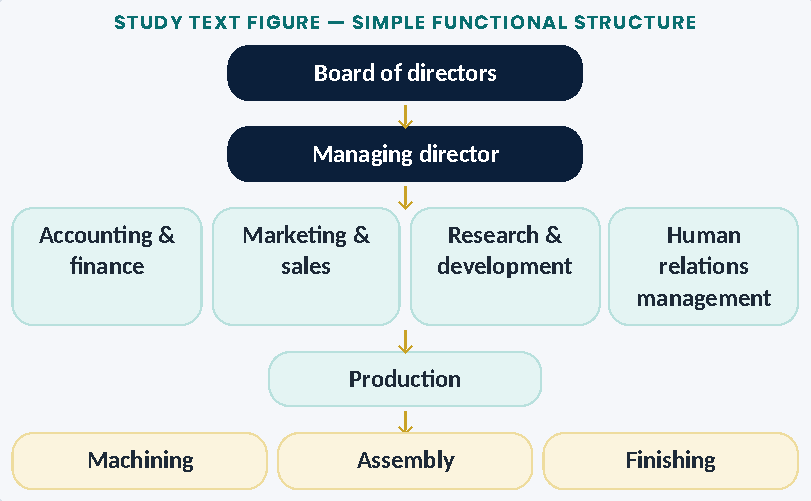
Functional Organisation
⚙️FEATURES
- Groups people with similar skills doing related tasks
- Typical for small to medium-size companies
- Each function headed by a specialist; has its own management & staff
- Functions: HR, operations, marketing, finance (business schools too)
✓ ADVANTAGES
✓ Simple to understand
✓ Staff specialise; shared interests & expertise
✗ DRAWBACKS (homogeneity)
✗ Hinders communication & decisions between units
✗ May promote interdepartmental conflict
CONFLICT EXAMPLE (STUDY TEXT) Marketing wants to maximise advertising expenditure ⇄ Accounting wants to control costs.
Divisional Organisation — Why & How
📌PROBLEM
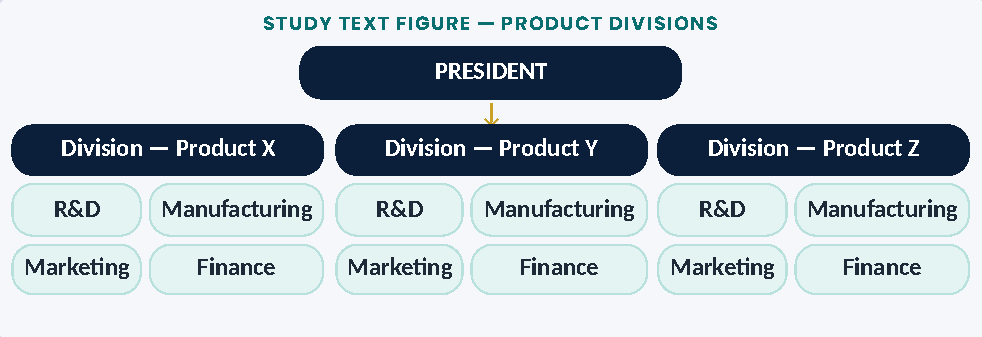
Large company as one unit under a functional structure is unruly Size makes it hard to oversee operations & serve customers
›
SOLUTION
Structure as divisions Similar to stand-alone companies
›
RESULT
Each division relatively autonomous Has most functional expertise it needs
KEY FEATURES
- Each division contains production, marketing, accounting, finance, HR expertise
- Certain common tasks (e.g. legal work) centralised at headquarters
- A corporate / head office function may provide shared services to all divisions
- Challenge: find the best way to structure operations to achieve overall company goals
4 Bases for Forming Divisions
📌Study Text examples
| Division basis | Meaning / benefit | Study Text example |
|---|---|---|
| Product | Organised by product lines; each division focuses entirely on its products. ✗ Higher costs — support services (accounting, HR) duplicated | General Motors: Buick, Cadillac, Chevrolet, GMC — each with own R&D, manufacturing & marketing |
| Customer | Better serve various categories of customers | Healthcare firm: consumer (personal-care & hygiene), pharmaceuticals (to pharmacies), professional (devices for physicians, hospitals, labs) |
| Process | Goods move through several steps in production | Canadian forestry company: tree cutting → chemical processing → finishing (≈90% pulp sold; 10% → newsprint) |
| Geographical | Operates in several locations; responsive to local customers; each region reports separately | Multinational: North America, Europe, Asia-Pacific, Latin America |
Summing Up Divisional Organisations
📌✓ ADVANTAGE
✓ Generally enhances the ability to respond to changes in the firm’s environment
✗ DISADVANTAGES
✗ Higher costs if services are duplicated across units
✗ Units may focus on their own needs & goals at the expense of the whole organisation
Case Study — Xyz: Structure for Product Innovation
📌Study Text case
①
PRODUCT TYPE DIVISIONS
MOST SIGNIFICANT Manage development, manufacturing, distribution & sale. Supports product differentiation (XYZ’s generic strategy) and its diverse portfolio.
Personal Care
Foods
Home Care
Refreshment
② CORPORATE EXECUTIVE TEAMS
SECONDARY
Based on business functions — e.g. finance team, marketing communications team → together form the XYZ Leadership Executive (XLE).
③ GEOGRAPHIC DIVISIONS
LEAST SIGNIFICANT
Support regional strategies (Europe ≠ Asia marketing) and analyse financial performance: Asia/Africa/Middle East/Turkey/Russia/Ukraine/Belarus · America · Europe.
✓ ADVANTAGES
✓ Supports product development & innovation — semi-autonomous divisions develop products for segments
✓ Differentiates products despite large-scale global operations
✗ DISADVANTAGE → IMPROVEMENT
✗ Minimal support for regional strategic implementation → Increase emphasis on geographic divisions to empower regional teams.
Matrix Organisation
📌KEY FEATURES
- Multiple command system + support mechanisms, culture & behaviour (Davis & Lawrence 1977)
- Not the traditional hierarchical model — dual reporting for all employees
- a.k.a. the project management approach
- Combines functional + product departmentalisation
- Two supervisors: functional line manager + project manager
- Vertical command overlaid with horizontal authority
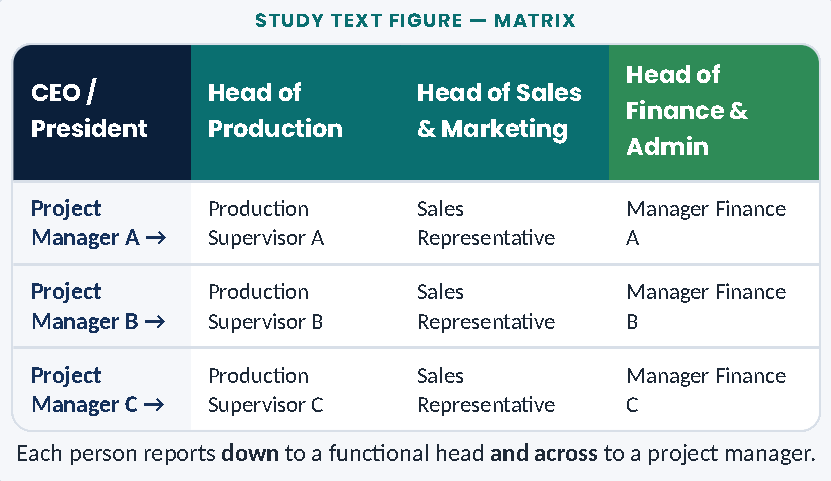
ORIGIN First used in defence & aerospace (e.g. aircraft for a government client). Problem: in a functional structure no one was responsible for the whole project (on time, within budget) → project managers given overall responsibility;
functional managers kept decision-making authority → dual command.
MATRIX vs PROJECT ORGANISATION Project organisation: project management ends when the project is completed. Matrix: authority & command structure is permanent.
Matrix should: encourage communication; emphasise ‘getting the job done’ over defending positions.
STUDY TEXT EXAMPLES
Large company: divisional managers (market/product profitability) + head-office functional managers.
University: heads of faculty/department + course-based lecturers managing staff, rooms, exams.
Comparing the Basic Structures
⚖️Built only from Study Text points
| Basis | ENTREPRENEURIAL | FUNCTIONAL | DIVISIONAL | MATRIX |
|---|---|---|---|---|
| Organised around | The entrepreneur-owner | Similar skills / business functions | Products, customers, processes or geography | Functions + projects/products (dual) |
| Best suited to | Early phases of an entity’s life | Small to medium-size companies | Large companies | Major projects; defence & aerospace origin |
| Decision-making | Centralised — owner does not delegate | Centralised (Study Text example) | Divisions relatively autonomous; geographical = decentralised | Decentralised (Study Text example) |
| Reporting | No formal management structure | Each function has its own management | Division managers; HQ handles common tasks | Two supervisors — line + project manager |
| Key strength | Direct connection with employees | Simple; specialisation | Responds to environmental change | Communication; ‘getting the job done’ |
| Key weakness | Inefficient as entity expands | Poor inter-unit communication; conflict | Duplicated costs; units’ own goals | — |
Virtual Organisations
📌WHAT IT IS
- No identifiable physical existence — no head office or operational premises
- May have no employees or assets
- One person or a few can indirectly control many external entities
OPERATED BY MEANS OF a IT systems & communication networks — normally telephone & e-mail b Specialised business partners for outsourcing key operations
KEY TO SUCCESS Effective
management of external relationships & co-ordination of their activities.
STUDY TEXT EXAMPLES Small — house builder runs from home; hires skilled & unskilled labour per job, supervises; accounting firm handles invoicing. Core competence = personal skill & experience. Large — branded footwear: core competence = brand name; outsource manufacturing (developing countries), warehousing, self-employed sales reps, marketing agency.
Globalisation
📌MEANING Increasing integration of economies, cultures and markets. Businesses are no longer confined within national boundaries — a product may be designed in one country, manufactured in another, assembled in a third and sold globally. MNOs are key players; emerging markets drive global growth.
i International
trade expansion Produced in one country, consumed globally; free
trade agreements encourage exchange
ii Cross-border
investment MNCs invest in subsidiaries, factories, offices; FDI gives access to markets & resources
iii Global
communication & technology Digital platforms, internet, logistics → coordinate across countries in real
time
iv Mobility of
labour & capital Skilled professionals migrate to hubs; capital
flows freely
v Standardisation
& cultural exchange Global brands standardise (with local adaptations); tastes converge, cultural identity remains
MULTINATIONAL ORGANISATIONS — FEATURES
- Large-scale global operations — HQ in one country, subsidiaries worldwide
- Economies of scale → cost efficiencies
- Transfer of technology & knowledge
- Global supply chains — design, production, sales across nations
- Corporate influence on trade, employment, even government policy
EMERGING MARKETS — CHARACTERISTICS
- Rapid economic growth & industrialisation
- Large consumer bases, rising middle class
- Attractive for investment — cheaper labour & expanding demand
MNOs see them as engines of future growth: lower production costs + increasing purchasing power.
✓ OPPORTUNITIES New markets · lower costs · diversified risk · greater profits
✗ CHALLENGES Cultural differences · political instability · exchange rate risks · ethical concerns (labour exploitation)
STRATEGIC RESPONSE Balance global efficiency with local responsiveness — the ‘global–local balance’
Key Elements of Organisational Structure — 6 Building Blocks
📌Departmentalisation
Chain of command ★
Span of control ★
Levels of management
Centralisation /
decentralisation ★
Work specialisation
★ Fundamental — applicable to every type of organisation.
Departmentalisation
📌MEANING How activities & people are grouped into units. Once work is divided into jobs, they must be coordinated — departmentalisation groups similar tasks to provide that framework. Choice depends on nature, size & strategy; many use a hybrid of two or more methods.
| Form | Groups jobs by… |
|---|---|
| i. Functional | Specialised functions — marketing, finance, production, HR |
| ii. Product | Specific products or product lines |
| iii. Geographical | Location, territory or region |
| iv. Customer | Customer type — retail, corporate, government |
| v. Process | Stages in the production process or workflow |
Chain of Command
📌MEANING An unbroken line of authority from the top of the organisation (e.g. the CEO) all the way down to the bottom. It clarifies who reports to whom. One of the most basic elements of structure.
CEO
↓
Managers
↓
Supervisors
↓
Employees
ILLUSTRATIVE
Span of Control
📌MEANING The number of subordinates a superior can effectively manage. The higher the ratio of subordinates to superiors, the wider the span.
SPAN OF CONTROL DEPENDS ON (5 FACTORS)
- Manager’s capabilities (physical & mental limitations)
- Nature of the manager’s workload
- Nature of the work — how routine it is
- Geographical dispersion of subordinates
- Level of cohesiveness within the team
TALL-NARROW
- Each manager has a small number of direct subordinates
- Many layers of management (large organisation)
- Span narrow; shape tall
WIDE-FLAT
- Each manager has a large number of direct subordinates
- Few layers even in a large organisation
- Span wide; shape flat (Self-Test Q10)
Levels of Management
📌MEANING The hierarchy of authority — how responsibilities are distributed across layers. Number of levels depends on size & complexity and the span of control.
1
Top-level management — CEO, board of directors, managing director → set overall strategy, define goals, make long-term decisions
2
Middle-level management — departmental heads, division managers, branch managers → translate strategic goals into operational plans; coordinate across departments
3
Lower-level (supervisory) — supervisors, team leaders → oversee day-to-day operations, monitor performance, ensure tasks done efficiently
Centralisation vs Decentralisation
⚖️| Basis | CENTRALISED | DECENTRALISED |
|---|---|---|
| Decision power | Concentrated at a single point; senior management retain most/all authority | Distributed across levels; delegated to lower units — SBU & divisional managers |
| Study Text examples | Functional, entrepreneurial | Matrix, geographical |
| Arguments for | Decisions consider corporate objectives as a whole · strong case for strategic decisions centrally · key decisions better coordinated · easier in a crisis | Local managers often have better knowledge of operational conditions · tactical & operational decisions often better locally (esp. large orgs) · delegation motivates management · quicker decisions — no referral to head office (Self-Test Q7) |
WHAT DECIDES THE CHOICE? Partly senior management’s preference, but size & complexity also influence it — a large, complex entity is hard to control from head office without delegating substantial authority (Self-Test Q13: TRUE).
Work Specialisation (Division of Labour)
📌✓ ADVANTAGES
✓ Efficiency through repetition & expertise
✓ Reduced training costs
✓ Higher productivity in routine/standardised processes
✗ DISADVANTAGES (EXCESSIVE)
✗ Boredom, monotony, low job satisfaction
✗ Reduced flexibility — narrow training
✗ Coordination problems between specialised roles
MODERN BALANCE Enough specialisation for efficiency, plus job rotation, enrichment or teamwork to maintain motivation.
Tall vs Flat — How the Key Elements Combine
⚖️Study Text table
| Key element | TALL | FLAT |
|---|---|---|
| Work specialisation | High degree | Low degree |
| Departmentalisation | Rigid (more traditional) | Loose (more contemporary) |
| Management layers | Many levels | Few levels |
| Span of control | Narrow | Wide |
| Decision-making | Centralised | Decentralised |
| Chain of command | Long | Short |
EXAMPLES Armed forces→ typicallytall Universities→flat
REALITY Most organisations fall between the two. Structure also depends on goals & objectives, size and the stability of the external environment.
How This Chapter Can Be Tested
📌1 Definition-based — structure, span of control, chain of command, matrix, virtual org, globalisation
2 Fill in the blank — “___ = number of subordinates a superior can manage” → span of control
3 True / False — size & complexity influence centralisation (T); tactical decisions locally (T)
4 Scenario identification — lines of business → divisional; grouped by expertise → functional
5 Statement-based — which statements are true for centralised / decentralised decisions
6 Comparison — tall vs flat; centralised vs decentralised; matrix vs project; traditional vs contemporary
7 Classification — 5 forms of departmentalisation; 4 division bases; 3 management levels
8 Cause → effect — span factors; wrong structure → tension, inefficiency, closure
Exam Traps
⚠️1 Span of control — = number of subordinates a superior can effectively manage (Q2) — not ‘control ratio’.
2 Wide ↔ flat, narrow ↔ tall — Wide span + few levels = wide-flat (Q10). ‘Tall-flat’ / ‘wide-short’ are distractors.
3 Chain of command — An unbroken line of authority; clarifies who reports to whom (Q8, Q9).
4 Multiple command system — = Matrix organisation (Q1) — every employee has dual reporting.
5 Matrix vs project — Project management ends with the project; matrix command structure is permanent.
6 Functional clue — Grouped by similar skills / expertise → functional (Q11, Q12).
7 Divisional clue — Organised by lines of business (products/customers) → divisional (Q4).
8 Which decisions where? — Strategic → centrally; tactical & operational → often better locally (Q3).
9 Centralised advantage — Key decisions better coordinated (Q6) — not ‘senior managers are always right’.
10 Examples by decision level — Centralised: functional, entrepreneurial. Decentralised: matrix, geographical.
11 Rigid vs dynamic — Traditional departmentalisation = rigid; matrix & committee = dynamic.
12 Entrepreneurial — No delegation, no formal structure, simple ops; suits early phases only.
13 Product divisions — Downside: duplicated support services → higher costs.
14 XYZ case — Product type divisions = most significant; geographic = least.
15 Emerging markets — Transitioning from developing to developed — not already developed.
16 Structure is fixed? — Naïve — structure must be continually assessed; a dynamic structure aids growth.
Decision Tree — Identify the Structure
📌READ THE SCENARIO → FIND THE KEY CLUE → SELECT THE STRUCTURE → CHECK THE CONDITION
1
Owner takes all decisions, no formal structure, simple ops → ENTREPRENEURIAL (check: early phase)
2
People grouped by similar skills / expertise → FUNCTIONAL (small–medium firm)
3
Autonomous units by product, customer, process or region → DIVISIONAL (which basis?)
4
Employees report to two bosses — line + project manager → MATRIX (permanent? else project org)
5
No premises; run via IT & outsourced partners → VIRTUAL
6
Few layers, wide span, decentralised → FLAT; many layers, narrow span → TALL
MCQ Quick-clue Section
🎯All 13 Self-Test questions
Multiple command system + culture
›
Matrix (Q1)
Number of subordinates a superior can manage
›
Span of control (Q2)
Tactical & operational decisions at local level
›
TRUE (Q3)
Lines of business — consumer, industrial, retail…
›
Divisional (Q4)
True for centralised decisions
›
All of the above (Q5)
Advantage of centralisation
›
Better coordination (Q6)
Feature of decentralisation
›
All of the above (Q7)
Unbroken line of authority top → bottom
›
Chain of command (Q8)
Chain of command…
›
Clarifies who reports to whom (Q9)
Wide span, flat shape, few levels
›
Wide-flat (Q10)
Comparable skills, similar tasks
›
Functional (Q11, Q12)
Size & complexity influence centralisation
›
TRUE (Q13)
Quick Memory Map
🧠| Concept | Key words | Core idea |
|---|---|---|
| Organisational structure | divide · assign · coordinate · authority | how the organisation is built |
| Entrepreneurial | owner decides · no formal structure · simple | early-stage organisations |
| Functional | similar skills · specialists · departments | simple; risk of conflict |
| Divisional | product · customer · process · geography | autonomous units; duplicated costs |
| Matrix | dual reporting · project manager · permanent | getting the job done |
| Virtual | no premises · IT · outsourcing partners | manage external relationships |
| Globalisation | trade · FDI · MNOs · emerging markets | global–local balance |
| Key elements | departments · chain · span · levels · (de)centralisation · specialisation | tall vs flat |
Business — Organization of Business in 60 Seconds
⚡⏱ STRUCTURE & TYPES
- Structure: formal division of tasks & flows
- Must suit size, operations, objectives
- 4 basic: entrepreneurial, functional, divisional, matrix (+ virtual)
- Matrix = dual reporting, permanent
⏱ GLOBALISATION
- Trade, FDI, technology, mobility, standardisation
- MNOs: scale, tech transfer, supply chains
- Emerging: growth, consumers, cheap labour
- Global–local balance
⏱ KEY ELEMENTS
- Chain = who reports to whom
- Span = no. of subordinates; wide → flat
- Strategic central; tactical local
- Tall: specialised, rigid, centralised, long chain
Test yourself on this chapter
Practice 100 MCQs per chapter with answers – Chapter 1 is free for everyone. Enrol on WhatsApp for all 8 chapters, classes and tests on our student portal.